
At a glance
- Location
- Boothapandi, Thovalai taluk
- Recommended time
- 2–3 hours for town and temple
- Best for
- Pilgrims, local culture and visitors interested in farming landscapes.
- Best time
- Choose a dry morning for the temple and public-road views of the fields. Crop colours depend on the farming cycle.
- Entry
- Arrange the temple visit during a confirmed worship session. Visitor information should be confirmed before travelling.
- Walking
- A short town walk is the easiest option; field bunds and private farmland are not public walking routes.
Before you go: Check the current temple programme for any festival visit.
Visit durations are editorial planning suggestions. Allow extra time for travel, queues and your group’s pace.
Why visit Boothapandi?
- Bhoothalingaswamy Temple and its stone mandapams
- The town associated with writer and reformer P. Jeevanandham
- Paddy fields below Tadagai Malai
How to reach
By bus
The Boothapandy Town Panchayat website lists routes 4, 4A, 4B, 4C, 4D, 4F, 4J, 318 and 319. It does not identify the boarding terminal or a dated operating timetable. At Nagercoil, ask staff which current bus goes to Boothapandy and where to change if needed.
By train
The town panchayat identifies Nagercoil as its railway gateway, about 13 km away. Check whether your arrival is at Nagercoil Junction (NCJ) or Nagercoil Town (NJT) and arrange the road connection.
By road
Use Boothapandy town as the road destination; the town panchayat locates Boothalingaswamy Temple on Boothapandi South Street. The bus stop-to-temple walking distance was not verified.
Official route listings checked: . Boothapandy Town Panchayat: Town Profile; District administration: How to Reach.
Checked the official web listing on 31 October 2026. This confirms what the authority publishes, not live operation. No departure times, frequency, fare or guaranteed return service verified. Confirm the destination, alighting stop and return service with bus staff. The panchayat route list is undated; do not label these as confirmed operating services.
Visitor information
- Timings and admission
- Visitor information should be confirmed before travelling.
- Festival planning
- The town panchayat records a January car-festival tradition. Use the temple's announced programme for the actual year's dates, queues and road controls.
Best time to visit
Choose a dry morning for the temple and public-road views of the fields. Crop colours depend on the farming cycle.
The temple car festival customarily falls in Thai, usually January–February; confirm the announced dates before planning a festival visit. Visit around current worship sessions. View fields and foothills from public roads and confirm permission before any hill walk.
Visitor information should be confirmed before travelling. Fees, permissions, facilities and last entry are not established unless explicitly sourced below.
Facilities, parking and accessibility
Confirm toilets, drinking water, parking, step-free access and assistance with the destination. A railway or bus arrival does not establish access to the entrance; plan any final walk or transfer for your group.
What to see and do
- Start with the temple and surrounding streets
- Read the town’s Jeevanandham connection
- Pause at a public view of the cultivated foothills
Important things to know before visiting
Check the current temple programme for any festival visit. Keep clear of chariot routes and do not enter planted fields for photographs.
Best way to experience this place
For families, keep the outing to the temple streets and a safe public viewpoint over the agricultural outskirts.
History and story behind the place
Start with the town
Boothapandi also appears as Boothapandy in official English usage. Both refer to the town in Kanniyakumari’s Thovalai taluk. Use the temple’s full name when asking for directions; a familiar spelling on a sign may differ from one on a map.
The town works well as a closer look at the inland district. The fields and settlements here are part of a working landscape, rather than scenery arranged around a visitor attraction.
A foothill town within working Nanjil Nadu
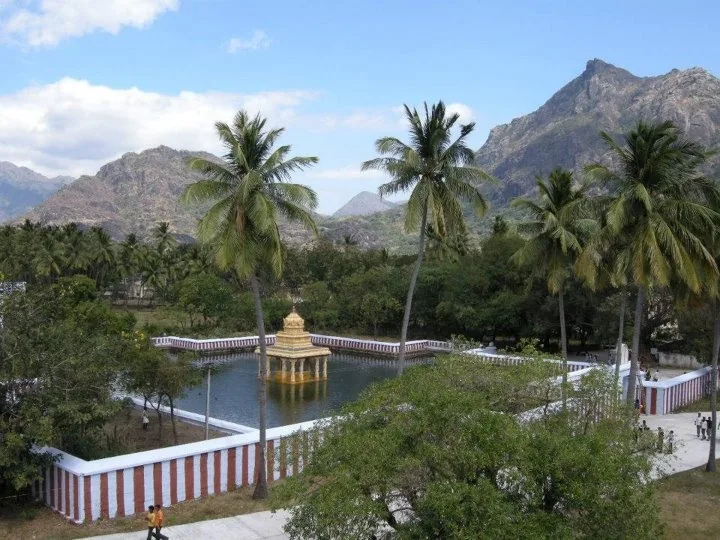
Boothapandi's setting brings together the foothills and the cultivated plain north of Nagercoil. Thadagaimalai and the Pazhayar basin provide its wider geographical frame, while agriculture is one of the occupations identified by the town panchayat. Fields, water channels and settlement edges belong in the town's story alongside its temple. The mountain backdrop may catch the eye first, but the more revealing detail is the close relationship between the built town and the land around it.
Paddy fields change visibly through a growing season: standing water, young plants, a dense green crop and harvested ground give the same outlook very different appearances. Coconut and banana cultivation add other textures to the wider agricultural landscape. A visit should leave room to notice those changes. The field is someone's workplace, and a public-road view often explains the setting better than walking into a crop to reproduce a photograph. The water and agriculture guide explains the larger irrigation network.
Boothalingaswamy and Sivakami at the town's centre
Sree Boothalingaswamy Sivakami Ambal Temple is the town's best-known religious landmark. Shiva is worshipped here as Boothalingaswamy, with Sivakami Ambal. That pairing is useful context for understanding the name of the shrine and the devotional life around it. Local explanations link the town's name with the deity and Pandya associations. Names can retain a community's historical memory even where the exact chronology of a place's earliest settlement remains uncertain.
The temple is a functioning sequence of spaces: approach, halls, carved pillars, shrines and the enclosed path used by worshippers. The mandapam provides a gathering space, while the inner shrine concentrates attention on the deity. These relationships give a first visit a structure. Walk through the complex with time to notice carved supports, changing light and the way its different parts serve worship; its architectural story is also a history of use and maintenance.
When the temple's celebration moves into the streets
The temple's January car festival is an important annual event in the town panchayat's profile. Its seasonal setting is the Tamil month of Thai, which overlaps January and February. Therottam means the drawing of the temple chariot: the deity's procession makes streets outside the daily worship space part of the festival. The event connects the shrine with residents, shopkeepers, visitors and the shared work needed to prepare a processional route.
The distinction between an ordinary temple visit and a festival visit matters. On a quiet day, the building and its surroundings are easier to study; during a procession, community participation and the movement of the chariot become central. Neither experience replaces the other. Consult the current temple notice for the particular year's sequence. The local authority's recurring-month description supports the tradition, while a fresh announcement establishes the actual day and arrangements. The festival calendar keeps these two kinds of information separate.
Reading a town through more than its monument
Boothapandi is also associated with P. Jeevanandham, the Tamil political figure and writer remembered as Jeeva. His public life connects the town with the twentieth century's movements for political freedom, social equality and Tamil literary engagement. That modern association adds another layer to a place often introduced only through its temple. Sacred traditions, agricultural work and political thought belong within the same town history rather than to separate worlds.
For a first visit, follow the visible relationships between the temple approach, ordinary streets and agricultural outskirts. Take time for the everyday scale of the place: a provision shop, a bus connection, a cultivated plot and a shrine can explain how the town functions. Boothapandi is a useful companion to Nagercoil because it brings the rural hinterland into the same story, rather than extending a cape itinerary with another isolated stop.
Boothalingaswamy and Sivakami Ambal
The town panchayat identifies Sree Boothalingaswamy Sivakami Ambal Temple as a principal landmark. Its January car-festival tradition connects worship with the surrounding streets. Exact dates and procession arrangements need the organiser’s annual programme.
Look at the entrance, streets and public spaces as well as the main building. Inside, follow the temple’s current access and photography rules. A visitor should never handle carvings to demonstrate a feature.
Make time for a smaller place
Pair the town with a modest inland route from Nagercoil, leaving time for the temple’s daily rhythm and a meal. Check local transport and the return connection before starting.
Geography, water and local life
Water fields and the foothills
The wider Nanjil Nadu landscape makes more sense when a field is understood as a place of work. Water has to reach it through rivers, channels or storage, and a crop’s appearance changes through the season. The irrigation story explains that larger connection.
Stay on public roads and paths around cultivated land. A green field does not imply a public walking route, and a farmer’s activity should not be interrupted for a photograph.
Read the temple town and the fields together
The full temple name, Boothalingaswamy Sivakami Ambal, identifies both the Shiva dedication and the goddess worshipped here. A town visit can move from that religious centre to the surrounding streets and then to views of the agricultural plain. The January car festival recorded by the panchayat makes that relationship especially clear: a celebration associated with the shrine also involves the routes and public spaces of the town.
The agricultural setting helps explain why the Pazhayar belongs in Boothapandi’s story. Irrigation is a relationship between a river, diversion works, channels and individual fields; the presence of green crops does not mean that each plot is supplied directly from the river beside it. Follow the Pazhayar account for that network. The town’s connection with Jeeva adds another layer, linking an apparently small settlement with Tamil writing and political life. A local memorial or account is best read for the person and period it actually commemorates, alongside the temple’s much longer institutional history.
What makes this place unique?
Boothapandi makes the relationship between a functioning shrine, a small town and cultivated Nanjil Nadu visible in one outing.
Combine this with nearby places
Pair Boothapandi with Nagercoil on an inland half-day route. Add Mukkadal only after its visitor access is confirmed; the reservoir needs a separate road leg.
Responsible visiting
Respect worship, avoid entering fields without permission, and leave room for festival processions.
Quick summary
Boothapandi suits a gentle temple-and-town outing. Allow 2–3 hours as an editorial suggestion, with the temple session and return transport settled before arrival.
Sources and further reading
Sources for visitor information and transport
- Boothapandy Town Panchayat: town profile — Temple identity, town location and agricultural setting; not current temple admission rules.
- Boothapandy Town Panchayat: Town Profile — Local authority's listed bus numbers; Nagercoil railway gateway about 13 km away; temple locality. No boarding stand or dated schedule.
- District administration: How to Reach — Nagercoil has Vadasery for mofussil routes and Anna Bus Stand for local routes; Nagercoil and Kanniyakumari are rail arrival hubs. No individual numbered bus service verified by this general page.
- Southern Railway: Trivandrum Division station list (1 April 2022) — Station identities and codes only: Nagercoil Junction (NCJ), Nagercoil Town (NJT), Kanniyakumari (CAPE); not a current timetable or proof of the nearest station to each attraction.
Verification note
Editorial review: . Transport guidance follows the dated source record above; this is not a live timetable confirmation. Current opening hours, fees and permissions have not been independently verified.
Historical references support the research passages they accompany. Editorial visit durations and recommendations are suggestions, not official operating information.