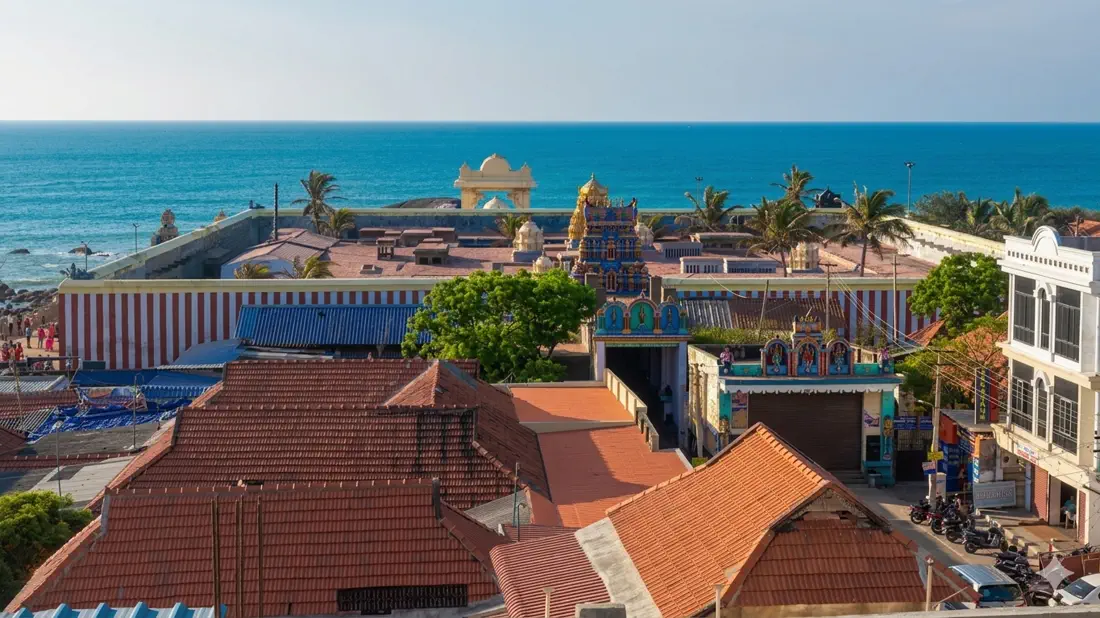
At a glance
- Best for
- History enthusiasts and visitors choosing a heritage itinerary
- Start here
- Choose one main monument and check its current entry arrangements in the destination guide. Leave time to look closely instead of trying to cover every historical period in a day.
Before you explore
Choose one main monument and check its current entry arrangements in the destination guide. Leave time to look closely instead of trying to cover every historical period in a day.
A temple tradition, an inscription and a later institutional account support different kinds of claims. Keep their dates and perspectives attached.
Visitor information should be confirmed before travelling. This article does not establish current opening hours, fees, programmes or services.
Best way to experience this
First notice what survives at the site. Read a plaque or inscription explanation, then compare the place with the historical context below.
What the earliest evidence tells us
A polished stone tool dated to about 1500–1000 BCE and old pottery found near Thoothur are among the earliest objects recorded in the district. We do not know the names of the people who made them. But these finds show that people lived here long before the surviving palaces and written records.
Old geographical writings also used forms of the name Komari for the cape. Its location at the end of the peninsula connected it by sea to the Indian Ocean and by land to the fertile plains and mountain passes.
History and tradition use different kinds of evidence. Stories about lost lands and cities are part of local cultural memory. Objects found by archaeologists, stone inscriptions and dated buildings give firmer evidence for historical claims. We can value both without treating a traditional story as proof.
Ay country and the world of Nanjil Nadu
In the Sangam age, the far south was linked with the Ay rulers and lay between the larger Chera and Pandya kingdoms. Sangam poems mention Nanjil Porunan, a ruler praised by poets including Avvaiyar. The poems do not give us an exact map, but they show that Nanjil was already a known and fertile area.
Nanjil Nadu is one of the district's most important old names. It mainly refers to the wet farming areas around today's Agastheeswaram and Thovalai, where tanks, channels, rain and good soil supported paddy fields. It does not mean the whole of today's Kanyakumari district.
The present Tamil Nadu–Kerala border did not exist then. People, languages, trade and worship moved across the region more freely than today's state boundary suggests.
Pandyas, Cholas and the rise of Venad
The Pandyas ruled much of the region for long periods. The Cholas expanded into the area around the tenth and eleventh centuries. Records call Nanjil Nadu Uthama Chola Valanadu and mention Chola-Pandya officials.
Rule did not change everywhere at the same time. A village could have a local leader while a larger kingdom also claimed the area. In later centuries, Venad became the main power in the south-west and later developed into Travancore.
Stone inscriptions are very useful because they may record a ruler, donor, place name, tax or gift from that period. The Tamil Nadu Department of Archaeology has recorded inscriptions at many places in the district, including Suchindram.
Sacred places hold many histories
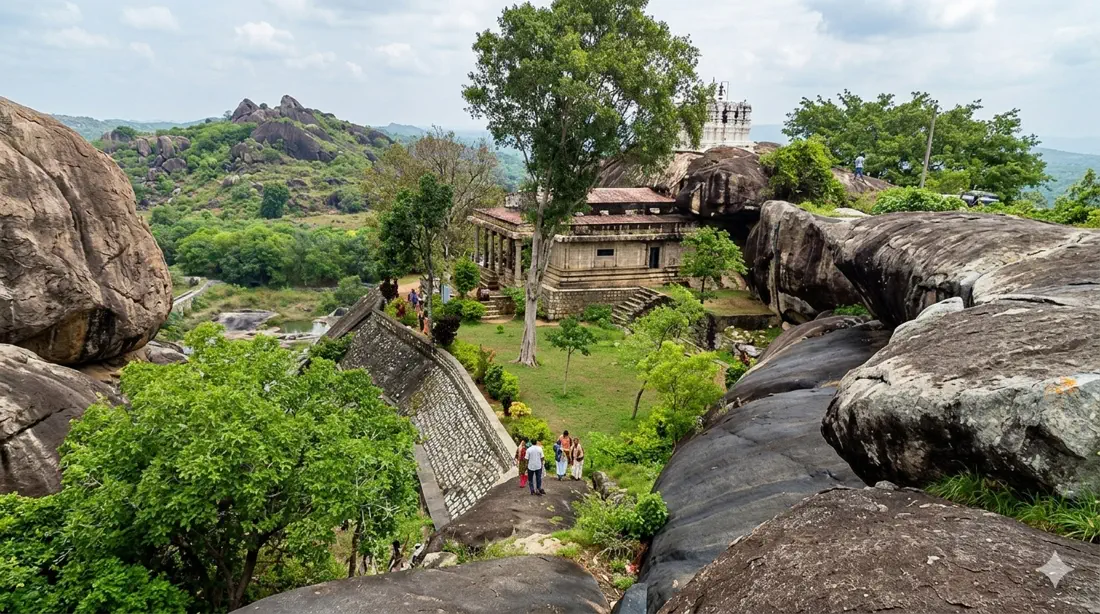
Chitharal, once known as Thirucharanathupalli, has rock-cut images of Jain Tirthankaras and other figures, mostly dated to the ninth century. A Bhagavathi shrine came later. This shows how one place can serve different communities across many centuries.
Other protected monuments include the rock-cut cave at Thirunanthikarai, the temple complex at Parthivapuram and Vattakottai Fort. Suchindram's Thanumalayan Temple preserves a long history of worship, sculpture, music and inscriptions. Together, these places show that the district's past is much more than the story of one ruler or capital.
Padmanabhapuram and the making of Travancore
The palace was first known as Kalkulam and grew under several rulers. Its oldest surviving parts are linked with the sixteenth century, and it expanded greatly during the seventeenth and eighteenth centuries. Marthanda Varma, who ruled from 1729 to 1758, strengthened Venad into the kingdom later known as Travancore.
In 1750, Marthanda Varma dedicated the kingdom to Sree Padmanabhaswamy. The royal centre then became known as Padmanabhapuram. The palace has a council room, performance hall, living rooms, kitchens, courtyards, wall paintings and fine woodwork. These spaces also tell us about the soldiers, cooks, performers, carpenters, painters and officials who worked there.
The royal centre later moved to Thiruvananthapuram. Padmanabhapuram, however, remains an important part of Travancore's southern history. The palace is in Tamil Nadu but is maintained by the Government of Kerala, showing the shared history of both states.
Read the palace as a workplace. Ask not only who occupied the throne, but who designed a roof for the monsoon, polished the dark floors, kept records, prepared food and carried news between the court and countryside.
Colachel, Udayagiri and military change
In the Battle of Colachel in 1741, Travancore defeated a Dutch East India Company force. Eustachius De Lannoy was among the captured soldiers who later joined Travancore's service. He helped train the army and strengthen forts.
Udayagiri Fort was rebuilt under Marthanda Varma and used for military stores and ammunition work. De Lannoy's tomb is inside its chapel. Vattakottai protected the eastern coast. Together, these places show how Travancore adapted European military methods for its own needs.
Travancore was a princely state. This means its ruler governed the state under British control, rather than the British running it directly as a district. British influence still grew in government, tax collection and foreign relations.
People, dignity, education and reform
The history of nineteenth-century south Travancore is not only about rulers. Caste rules created deep inequality, and people challenged them for many years. Women of the Nadar community fought for the right to cover their upper bodies. This struggle, often called the Upper Cloth movement, was about women's dignity and equal public rights.
Ayya Vaikundar and the Ayyavazhi tradition also arose in south Travancore. Teachings about equality, shared meals and human dignity challenged unfair practices. They continue to shape community life around Swamithoppu.
Mission schools, printing, courts and public groups helped more people gain education and take part in politics, though access was not equal. Farmers, palmyra workers, fishers, craftspeople, traders, teachers and women workers all helped build the district.
Roads, irrigation works and other public projects also changed the land. They helped farming and travel, but the benefits were not always shared equally. A full history must ask who gained, who did the work and whose land or water was affected.
The Tamil movement and the birth of the district
As British rule ended, Tamil-speaking people in southern Travancore wanted to join Madras State. The movement grew stronger in the 1940s. The All Travancore Tamil Congress began in 1946 and later became the Travancore Tamil Nadu Congress. A. Nesamony was its best-known leader.
The movement used elections, petitions, public meetings, marches and protests. Language was important, but people also wanted fair representation and better administration. Police action against protests caused deaths. The new state boundary therefore came after a serious local struggle.
Travancore joined India in 1947 and joined with Cochin in 1949. On 1 November 1956, the four southern taluks of Thovalai, Agastheeswaram, Kalkulam and Vilavancode became Kanyakumari district and joined Madras State. Nagercoil became the district headquarters. Madras State was renamed Tamil Nadu in 1969.
The modern district is formed from four former Travancore taluks.
The border changed, but old connections remained
Joining Tamil Nadu gave the district a new future, but it did not remove its older history. Tamil language and literature, memories of Travancore, links with Kerala architecture, Christian traditions, Jain and Hindu heritage, Ayyavazhi, Islam, coastal trade and local ways of speaking all remain part of Kanyakumari.
These different influences belong together. The coast, mountain routes and changing kingdoms brought people and ideas into the district. Padmanabhapuram Palace, maintained by Kerala while standing in Tamil Nadu, is a clear reminder that heritage can cross a modern state border.
How to keep exploring
- Chitharal Jain Monuments for religious and artistic history in stone.
- Padmanabhapuram Palace for Travancore government, architecture and craft.
- Suchindram Temple for worship, inscriptions, sculpture and music.
- People and living culture for traditions that remain part of the district today.
Help improve this history. If your family has an old photograph, letter, land record or remembered story, write to GoKanyakumari. Tell us the place, approximate date and who shared it, and give permission before we publish it. We will clearly label personal memories as memories.
A few documented points of orientation
The government tourism account connects Colachel with the battle of 1741 and De Lannoy’s later service. The palace’s tentative-list submission records the administrative relationship retained after the 1956 state reorganisation.
A chronological table is a starting point, not a claim that the years between its entries were empty. A temple legend or an undated village story belongs alongside historical evidence with its own kind of attribution.
| Date or period | Record | Continue |
|---|---|---|
| 1741 | Battle of Colachel in government tourism history | Colachel and Udayagiri |
| 1897–1906 | Pechiparai construction in the historical census account | Irrigation network |
| 1956 | State reorganisation and palace custodianship in the UNESCO submission | Padmanabhapuram Palace |
| 2014 | Palace submitted to UNESCO Tentative List | Tentative status, not World Heritage inscription |
History has more than one voice
Education and social change draws on attributed institutional histories. Kani research history shows why a story of benefit sharing needs more than one perspective.
Place-specific accounts matter too: Colachel, Udayagiri and Padmanabhapuram have different records and physical evidence. Link those records rather than repeating one broad narrative across every monument.
Irrigation is part of political and social history
The reservoir-and-channel landscape records a history of investment, labour and changing demands on land. Pechiparai’s construction in 1897–1906, Perunchani’s recorded development in 1953 and the Chittar works of 1964–70 span different administrative periods. Mathur’s 1966 aqueduct adds a visible example of later distribution infrastructure. These works connect the history of government with the history of fields and household livelihoods.
The effect of a public work cannot be read from its opening date alone. The questions include which land received water, how distribution was maintained and how agricultural work changed. The irrigation account follows the named works, while the farming story follows the people’s seasonal use of the landscape.
Read each site for the evidence it actually preserves
Chitharal’s Jain reliefs, Thirunandikkara’s inscriptions and mural documentation, the palace’s room sequence and Udayagiri’s memorials each preserve a different kind of history. The image of a religious teacher, a recorded gift, a working room and a commemorative inscription answer different questions. A district chronology becomes stronger when it points readers towards those specific records.
Oral accounts add another scale: a family’s use of a house name, a village’s memory of a reading room or a performer’s account of learning a story. Those voices explain how history continues to be understood. They should retain the speaker and setting rather than being turned into an anonymous statement about every person in the district.
What makes this part of Kanyakumari special?
Tamil cultural history, Venad–Travancore rule and the formation of the modern district can be explored through distinct local places.
Connect this with your visit
Padmanabhapuram and Udayagiri make a coherent heritage pairing. The Kanyakumari Day article supplies later district history as companion reading.
Responsible visiting
Do not rub inscriptions, touch fragile murals or climb protected masonry. Respect worship where a historical site remains a living shrine.
Quick summary
Choose a heritage site for what you can see, then use dated records and clearly labelled traditions to understand it.
Source and verification note
Editorial review: . This is a content review date, not confirmation of current visitor arrangements. Use the linked sources for the historical, scientific and cultural claims they support.