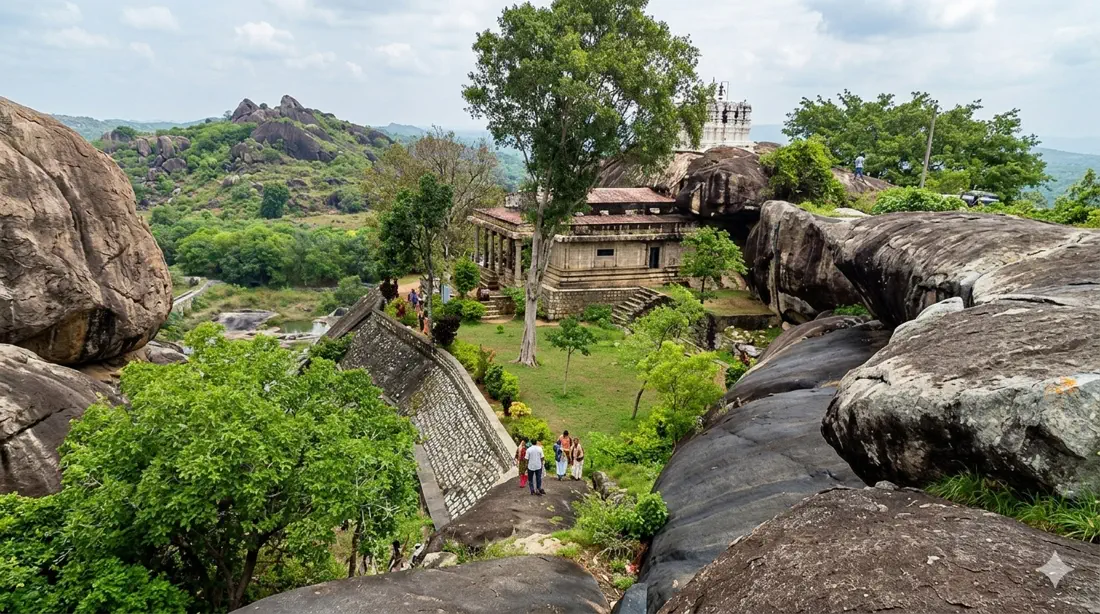
At a glance
- Location
- Chitharal hillock, western Kanyakumari district
- Recommended time
- 1½–2 hours including the hill approach
- Best for
- Rock-cut art, Jain heritage and visitors comfortable with an uphill walk.
- Best time
- A dry morning with confirmed access is preferable to midday heat. Postpone the climb during heavy rain or thunderstorms.
- Entry
- Confirm current monument access and any ticket requirements before the climb. Visitor information should be confirmed before travelling.
- Walking
- An uphill walk from the vehicle approach is required. Allow extra time for steps, exposed rock, heat and your group's pace.
Before you go: Rocks can be slippery when wet.
Visit durations are editorial planning suggestions. Allow extra time for travel, queues and your group’s pace.
Why visit Chitharal Jain Monuments?
- Jain reliefs carved into a natural rock face
- Tirthankara and attendant figures
- The relationship between the earlier Jain setting and later Bhagavathi worship
How to reach
By bus
The district lists 86A from Marthandam bus terminal via Gnaranvilai and Thickurichy for Chitharal. Confirm the stop for the hill entrance and arrange any remaining transfer; reaching the village does not remove the uphill walk. These are official published route listings, not live service confirmations. Confirm the destination board, boarding point, final stop and return service before travel.
By train
Kuzhithurai / Kulitturai (KZT) is identified by the district as the nearest station, about 9 km from the monument. Arrange road travel to the hill entrance and allow for the ascent.
By road
Approach the hill entrance from Chitharal village. The district notes that vehicles can reach the foot of the hill; the monument requires a walk uphill.
Official route listings checked: . Kanniyakumari District Administration: Chitharal Jain Caves; Kanniyakumari District Administration: Chitharal Jain Rock Cut Temple.
Exact drop-off, ascent time, return timetable and fares not verified. Official pages give conflicting distances from Kanniyakumari, so those distances were omitted.
Visitor information
- Hours and entry
- Visitor information should be confirmed before travelling.
- Approach and mobility
- The district account places vehicle access at the hill base, followed by a walk. Ask locally about the present approach and assistance; do not assume step-free access.
Best time to visit
A dry morning with confirmed access is preferable to midday heat. Postpone the climb during heavy rain or thunderstorms.
Allow for an uphill walk, exposed rock and rest stops. Choose daylight, carry water and reconsider the ascent when surfaces are wet. Observe the Jain carvings and later shrine context from permitted positions without touching the reliefs.
Visitor information should be confirmed before travelling. Fees, permissions, facilities and last entry are not established unless explicitly sourced below.
Facilities, parking and accessibility
Confirm toilets, drinking water, parking, step-free access and assistance with the destination. A railway or bus arrival does not establish access to the entrance; plan any final walk or transfer for your group.
Earlier visitor notes
Background notes: current arrangements require confirmation. Use the dated official source record for the scope of verified details.
Visit with time and care
Chitharal is on a hill near Marthandam. The walk is uphill, so think about the heat, rain and each person's walking ability before starting. Check locally if you need help with access.
Find it on our district map. Do not try to combine a distant coastal visit and several inland places in one short afternoon.
What to see and do
- Reach the authorised hill approach
- Walk slowly to the carvings with time for breaks
- Observe the reliefs and later shrine context before descending in daylight
Important things to know before visiting
Rocks can be slippery when wet. Carry water, keep back from edges and do not touch or rub images and inscriptions.
Best way to experience this place
For families, assess the climb before starting and turn back early if the heat or footing is unsuitable. The outing does not need to include every rocky viewpoint.
History and story behind the place
A Jain chapter in the south
Chitharal was earlier known as Thirucharanthupalli and was connected with Digambara Jain monks. Its rock-cut sculptures of Tirthankaras, the spiritual teachers of Jainism, are dated to the ninth century.
Chitharal adds an important chapter to Kanyakumari's history. Along with the district's temples, churches and coastal monuments, it shows that Jain communities once lived and worshipped here. It also shows the skill of stone carvers.
Why Chitharal matters to us
Chitharal helps families and students learn that Kanyakumari has many religious and artistic traditions. It also shows how local settlements and beliefs changed over time.
Caring for the site is part of respecting it. Do not write on the rocks, rub the inscriptions or touch the carvings. Take a photo or make a written note instead.
Its place in inland Kanyakumari
Chitharal is about 7 km from Marthandam and 55 km from Kanyakumari. Plan it with other inland places instead of adding it after a full day at the cape.
Visit it along with Padmanabhapuram Palace. Chitharal preserves rock-cut religious history, while the palace shows a royal building tradition. Together they show the variety of Kanyakumari's past.
Festival information: no regular festival programme has been confirmed for this monument. Check locally if you plan to visit for a special occasion.
Two rock-cut places with different records
Thirunandikkara introduces another cave and the history of its mural documentation. A comparison can illuminate carving and conservation without transferring one site’s date or religious history to another.
Walk within the authorised approach and avoid contact with carved or painted surfaces. The surrounding landscape is part of the experience, not a reason to leave the public path.
Tirthankaras and the community around a rock shelter
Tirthankaras are teachers in Jain tradition, represented through established postures and identifying details. The district’s account describes Chitharal’s reliefs as including Tirthankaras and attendant deities. Looking at the group rather than only the largest figure makes the site’s religious identity clearer: the arrangement belongs to a tradition of images, worship and community patronage.
The inscriptions add another kind of evidence. An image communicates through form and placement; a written record may identify a donor, a gift or an institution. Neither should be assumed to date every neighbouring feature. A ninth-century attribution for Jain reliefs and a later Bhagavathi phase describe layers within the same site, rather than one building event.
A Jain monument with a later Bhagavathi history
The district administration places a Bhagavathi-temple phase in the thirteenth century. That later worship is part of the site’s history, while the surviving Jain images preserve its earlier identity. A concise description of ‘conversion’ can obscure the longer sequence of use, patronage and survival. The carvings deserve to be understood on their own terms alongside the later shrine.
The hill setting also matters. The approach leads from a settled landscape into a natural rock formation adapted for religious use. Once there, compare the carved surfaces with the shelter and the spaces made for gathering. This is a useful counterpart to Thirunandikkara, where rock-cut architecture and fragile mural traces raise different questions about what survives.
Architecture and cultural heritage
How to look at a carving
The site has Tirthankara carvings, old written inscriptions and a Hindu goddess temple. These belong to different periods and religious traditions. Each part deserves respect.
Look at how the figures were cut into the natural rock. Notice their arrangement, the rock shelter and how the light changes. Use the signs or ask a local guide to identify the figures.
Look closely: Choose one figure and notice its posture and nearby details. Do not touch the carving.
A cave, carved walls and inscriptions
The monuments use the natural hill and rock shelter. The site has a pillared mandapam or hall, three inner shrines, wall carvings and inscriptions. The Jain carvings and the goddess shrine belong to different chapters of the site's history.
In Jain belief, Tirthankaras are spiritual teachers who show the path to freedom from the cycle of birth. The inscriptions can tell us about names, dates and gifts. Do not give a carving an exact date or ruler unless a reliable inscription or expert record supports it.
Reading a carved figure
Begin with the figure, its setting and the details actually visible. A name supplied by a site record is different from one inferred from a photograph.
Nagaraja Temple also has Jain figures identified in the district’s official record, but those images belong to a separate site and do not establish the same chronology as Chitharal.
What makes this place unique?
The natural shelter and Jain reliefs show a religious and artistic history different from the district's better-known large structural temples.
Combine this with nearby places
Combine Chitharal with one western-district heritage stop such as Thirunandikkara or Thiruvattar. Avoid adding all the inland attractions to a rushed cape day.
Responsible visiting
Do not rub inscriptions, chalk carvings or climb onto protected reliefs.
Quick summary
Chitharal suits visitors who enjoy art and a hill walk. Allow 1½–2 hours as an editorial suggestion, with a dry-weather plan and a confirmed return journey.
Sources and further reading
Sources for visitor information and transport
- Kanniyakumari District: Chitharal Jain Rock Cut Temple — Jain reliefs, hill approach and vehicles reaching the hill base; no current hours or ticket tariff established.
- Kanniyakumari District Administration: Chitharal Jain Caves — 86A from Marthandam via Gnaranvilai/Thickurichy.
- Kanniyakumari District Administration: Chitharal Jain Rock Cut Temple — Kuzhithurai as nearest railway station, around 9 km from the monument; vehicles reach the foot of the hill.
- Southern Railway: Thiruvananthapuram division station list — Station identities/codes NCJ, ERL and KZT only; not a current train timetable, last-mile distance survey or proof of nearest station.
Verification note
Editorial review: . Transport guidance follows the dated source record above; this is not a live timetable confirmation. Current opening hours, fees and permissions have not been independently verified.
Historical references support the research passages they accompany. Editorial visit durations and recommendations are suggestions, not official operating information.