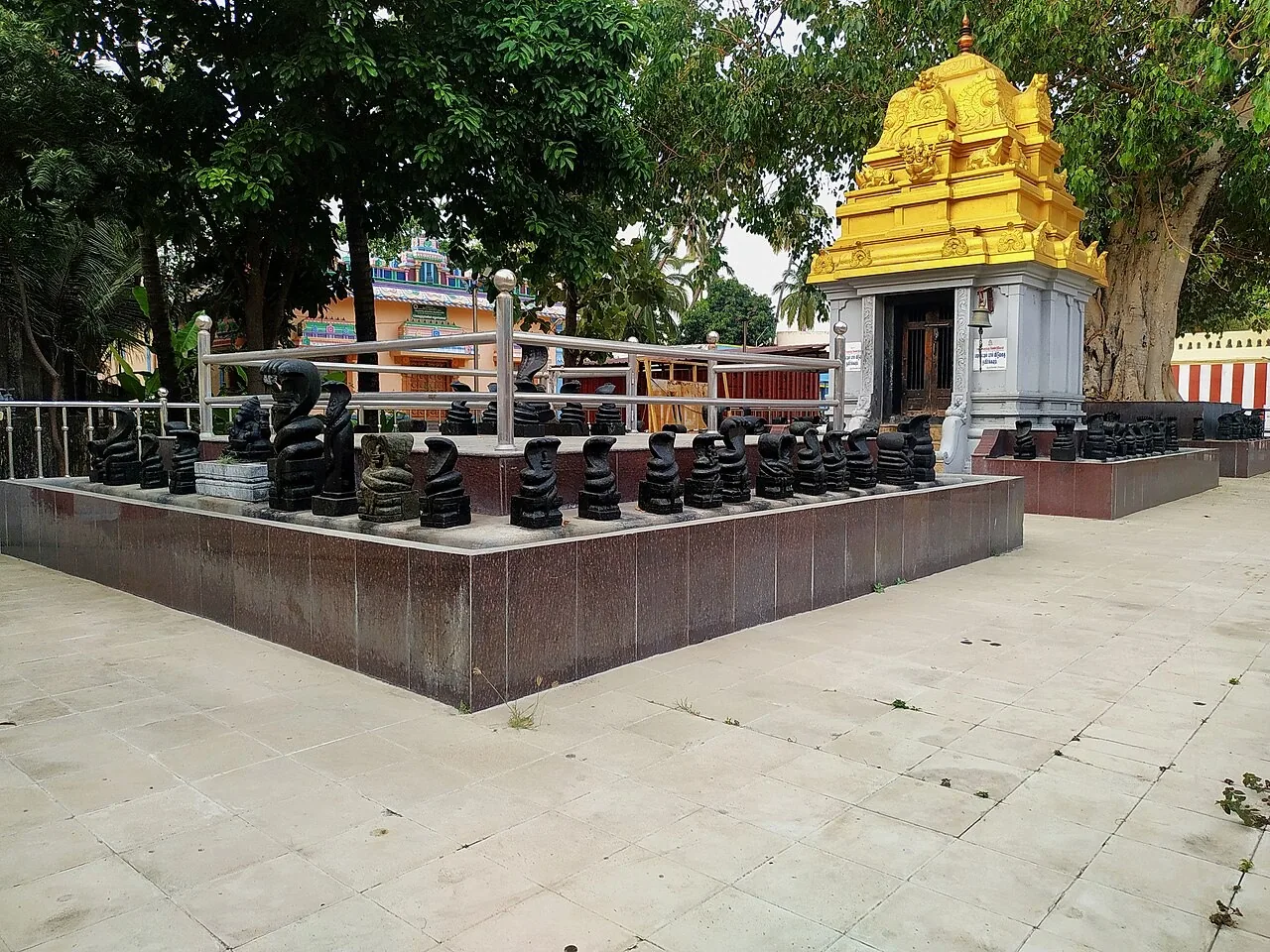

At a glance
- Location
- Nagercoil city
- Recommended time
- 45–90 minutes plus worship queues
- Best for
- Pilgrims, local history and visitors interested in religious art.
- Best time
- Choose a confirmed morning session and combine it with a short town walk. Ask about festival crowds if the shrine is your principal reason for travelling.
- Entry
- Confirm the temple's current admission and worship arrangements. Visitor information should be confirmed before travelling.
- Walking
- Keep time for footwear-free walking and queues; ask staff about assistance and permitted access.
Before you go: Respect the sanctum and all offerings.
Visit durations are editorial planning suggestions. Allow extra time for travel, queues and your group’s pace.
Why visit Nagaraja Temple and the name of Nagercoil?
- Serpent worship associated with the city’s name
- The palm-thatched sanctum tradition
- Earth prasadam and the research account of Jain imagery
How to reach
By bus
The official Nagaraja Temple page lists 1, 2, 3 and 31A from Vadasery via Stadium. It lists 1, 2 and 303 from Kanniyakumari via Kottaram and Suchindram, and 303/382/451 from Kaliyakkavilai via Marthandam and Nagercoil. Its Anna row says '4 Sector / 15 Sector', so no individual 4/15-series service is inferred. Confirm the temple alighting stop.
By train
Nagercoil Junction (NCJ) is a practical major arrival hub. Nagercoil Town (NJT) is a different station: check which one your train serves and arrange a separate town transfer.
By road
Give the full name Nagaraja Temple, Nagercoil, for the town transfer. The official page establishes the approach localities but does not specify a bus stop at the temple entrance.
Official route listings checked: . District administration: Sri Nagaraja Temple; District administration: How to Reach.
Checked the official web listing on 31 October 2026. This confirms what the authority publishes, not live operation. No departure times, frequency, fare or guaranteed return service verified. Confirm the destination, alighting stop and return service with bus staff. No claim is made that all listed buses reach the entrance; the Anna sector labels are not individual verified numbers.
Visitor information
- Published timings
- The district page lists 06:00–12:30 and 18:30–20:30. Last verified: 31 October 2026. Confirm with the temple before travelling; rituals may affect access.
- Entry and photography
- A current general admission tariff and camera policy have not been established. Visitor information should be confirmed before travelling.
Best time to visit
Choose a confirmed morning session and combine it with a short town walk. Ask about festival crowds if the shrine is your principal reason for travelling.
Ayilyam worship in Aavani is an important customary season; confirm the current festival programme. Follow the admitted worship route and current photography rules. Earth prasadam is a religious practice and should not be interpreted as medical advice.
Visitor information should be confirmed before travelling. Fees, permissions, facilities and last entry are not established unless explicitly sourced below.
Facilities, parking and accessibility
Confirm toilets, drinking water, parking, step-free access and assistance with the destination. A railway or bus arrival does not establish access to the entrance; plan any final walk or transfer for your group.
What to see and do
- Visit during a confirmed worship session
- Observe the permitted shrine and mandapam areas
- Continue with one Nagercoil neighbourhood rather than several rushed stops
Important things to know before visiting
Respect the sanctum and all offerings. Do not collect soil or handle sacred objects unless directed by temple staff.
Best way to experience this place
For families, keep the visit focused on the shrine and the images visible from permitted areas, then take a town break.
History and story behind the place
Nagaraja and the city that carries the temple's name
Nagaraja means serpent king, and the district administration connects Nagercoil's name with this shrine. The temple therefore gives the city an identity that is religious as well as administrative. Its place in the urban landscape is easy to miss if Nagercoil is treated only as a station or overnight base. A visit brings the city's name back into view through an active place of worship and the streets that serve it.
Serpent imagery belongs to a broad range of South Asian religious traditions, so the presence of a naga alone cannot establish a temple's whole history. Here the deity's identity should be understood together with the other shrines and sculptures in the complex. That combination is more informative than a single origin legend. It allows the visitor to ask how a place acquires several devotional and artistic associations over time, while retaining a strong identity in present-day worship.
Shiva and Ananthakrishna within the same complex
The district's dedicated temple listing names Shiva and Ananthakrishna alongside Nagaraja. The building is therefore not explained by serpent worship alone. Ananthakrishna's name itself points towards the relationship between Krishna and the serpent Anantha in the wider Vaishnava religious world. The arrangement invites a patient visit through the complex, paying attention to which deity is being worshipped at each shrine and how devotees move between them.
This is a useful introduction to the district's layered sacred geography. Suchindram expresses a different relationship between major deities through Sthanumalayan, while Thiruvattar centres on reclining Adikesava. The comparison is most rewarding when the specific forms are kept clear. Shared elements do not mean identical histories or rituals. They show how neighbouring communities and patrons have given different architectural and devotional forms to connected religious ideas.
The temple as part of a Nagercoil visit
The approach to a working town temple adds a different kind of detail from the major coastal monuments. Shops supplying flowers or offerings, everyday traffic and the rhythm of worship connect the sanctuary with the city's routine. Those details matter because heritage survives through use as well as through preservation. A temple street can show the relationship between a religious institution and the people whose work supports visitors and residents throughout the year.
From here, the Nagercoil town guide leads into Kottar, Vadasery and the city's craft and institutional histories. The temple-jewellery story is especially useful for understanding why an adorned deity and a skilled urban craft belong within the same regional history. A visit can move from the religious meaning of an ornament to the knowledge and labour of those who make it, then into the markets and working streets of the city.
Tradition and present practice
Visitors may encounter accounts of earth or sand given as prasadam. Ask the temple about the practice and its religious meaning. Sacred significance is different from a demonstrated medical benefit.
Follow current rules around the sanctum, dress, photography and offerings. A small architectural detail can be observed without disturbing worship or handling the structure.
Serpent worship and Jain imagery need separate explanations
The serpent has a clear role in the temple’s present identity: Nagaraja is the serpent king, while Ananthakrishna’s name connects Krishna with Anantha. The Jain figures identified by the district belong to a different religious vocabulary. Mahavira and Parsvanatha are Tirthankaras, teachers in Jain tradition; their presence deserves to be recognised rather than absorbed into a general label of ‘old Hindu carvings’.
The survival of those figures alongside active worship makes Nagaraja an instructive town-temple visit. It allows present practice and historical art to be considered together. It does not, by itself, establish a single moment when the whole complex changed religion. Chitharal supplies a larger Jain monumental setting, while Nagaraja shows why a city shrine can preserve evidence that exceeds the history suggested by its present name.
Continue through the city
Make the temple part of a considered city visit rather than a hurried stop between distant attractions. Vadasery craft traditions and local food provide other ways to understand the area.
For a different encounter with Jain heritage, Chitharal offers a separate site and historical context. Its carvings should be understood on their own evidence, not treated as identical to those at Nagaraja.
Architecture and cultural heritage
What the Jain sculptures allow us to say
The official temple listing identifies figures of Mahavira and Parsvanatha on the pillars. These Jain images are an important part of the site's art history. Parsvanatha is often recognised through the protective serpent hood associated with him; Mahavira is another of the Jain Tirthankaras. Identifying figures and their attributes can make a carved pillar far more legible than looking at it simply as decorative stonework.
The Jain images bring another artistic and religious vocabulary into a temple where Nagaraja, Shiva and Ananthakrishna are worshipped today. Look at the figures' attributes and their position on the pillars as well as their names. Chitharal provides a complementary encounter with Jain sculpture in the district, there carved into a hilltop setting. Together they show how the region's sacred art can be followed across different materials, landscapes and present-day places of worship.
Earth prasadam and the palm-thatched sanctum
The HR&CE department’s regional temple account describes Nagaraja’s palm-thatched sanctum and earth given to devotees as prasadam. These connect the shrine’s distinctive material setting with worship. Prasadam here refers to a sacred gift received through the temple’s practice, rather than an ordinary souvenir collected from the grounds.
The same account describes a seasonal change in the earth’s colour. That is the temple account’s description, not a chemical analysis or a treatment claim. Ask temple staff about the observance during your visit and receive offerings through the authorised arrangements.
What makes this place unique?
The serpent shrine and Jain imagery give visitors a concrete way to understand the different religious layers behind Nagercoil's identity.
Combine this with nearby places
Combine the temple with Kottar or Vadasery in Nagercoil. Suchindram belongs on a separate southbound road leg towards the cape.
Responsible visiting
Do not remove earth, touch icons or enter areas outside the admitted worship route.
Quick summary
Nagaraja Temple is a useful starting point for Nagercoil. Allow 45–90 minutes as an editorial suggestion and confirm dress, photography and worship arrangements.
Sources for visitor information and transport
- Kanniyakumari District: Sri Nagaraja Temple — Nagaraja worship, Jain images and published opening sessions.
- District administration: Sri Nagaraja Temple — Destination-specific route listings; Anna row describes sectors rather than a precise route.
- District administration: How to Reach — Nagercoil has Vadasery for mofussil routes and Anna Bus Stand for local routes; Nagercoil and Kanniyakumari are rail arrival hubs. No individual numbered bus service verified by this general page.
- Southern Railway: Trivandrum Division station list (1 April 2022) — Station identities and codes only: Nagercoil Junction (NCJ), Nagercoil Town (NJT), Kanniyakumari (CAPE); not a current timetable or proof of the nearest station to each attraction.
Verification note
Editorial review: . Transport guidance follows the dated source record above; this is not a live timetable confirmation. Last verified for the explicitly sourced visitor details: 31 October 2026.
Historical references support the research passages they accompany. Editorial visit durations and recommendations are suggestions, not official operating information.