At a glance
- Location
- Suchindram, between Nagercoil and the cape
- Recommended time
- 1–2 hours plus worship queues
- Best for
- Pilgrims, families interested in temple art and architecture enthusiasts.
- Best time
- Visit during one confirmed worship session, allowing time to see the permitted halls without rushing towards closing.
- Entry
- Follow the temple's current admission and worship arrangements; special services may have separate booking. Visitor information should be confirmed before travelling.
- Walking
- Plan for footwear-free walking and time standing in queues; confirm mobility help directly.
Before you go: Respect dress and photography rules.
Visit durations are editorial planning suggestions. Allow extra time for travel, queues and your group’s pace.
Why visit Suchindram Temple?
- The combined Sthanu–Mal–Ayan tradition
- Carved mandapams and the musical pillars
- Hanuman worship and the streets used by the temple car festival
How to reach
By bus
The official Suchindram page lists 1, 2, 3 and 303 from Nagercoil's Vadasery and Anna stands. From Kanniyakumari it lists 1, 2, 303, 349 and 350 via Kottaram; 303 is also listed from Marthandam and Kaliyakkavilai via Thuckalay and Nagercoil. Ask for Suchindram and confirm the temple stop before boarding.
By train
Use Nagercoil Junction (NCJ) as a major railway gateway and continue by road to Suchindram. A current passenger stop at Suchindram railway station was not established; do not book on that assumption.
By road
Suchindram is on the approach between Nagercoil and Kanniyakumari. Continue from the confirmed local bus stop to the temple; an exact walking distance and current parking arrangement were not established.
Official route listings checked: . District administration: Sri Thanumalayan Swamy Temple; District administration: Temples / Churches / Masjids.
Checked the official web listing on 31 October 2026. This confirms what the authority publishes, not live operation. No departure times, frequency, fare or guaranteed return service verified. Confirm the destination, alighting stop and return service with bus staff.
Visitor information
- Temple timings
- HR&CE lists 04:00–12:30 and 16:30–20:30. Last verified: 31 October 2026. Festival and ritual arrangements may alter access.
- Entry and services
- No general admission tariff is established here. Use the temple authority for any special worship booking. Visitor information should be confirmed before travelling.
Best time to visit
Visit during one confirmed worship session, allowing time to see the permitted halls without rushing towards closing.
Choose a worship session and allow time for footwear arrangements. The car festival customarily takes place in Margazhi, usually December–January; confirm its annual dates. Observe the musical pillars without striking them and follow temple photography rules.
Visitor information should be confirmed before travelling. Fees, permissions, facilities and last entry are not established unless explicitly sourced below.
Facilities, parking and accessibility
Confirm toilets, drinking water, parking, step-free access and assistance with the destination. A railway or bus arrival does not establish access to the entrance; plan any final walk or transfer for your group.
Earlier visitor notes
Background notes: current arrangements require confirmation. Use the dated official source record for the scope of verified details.
Visit as a guest
Follow the temple's current rules on dress, access and photography. Do not strike or handle architectural features, even when a popular account describes their sound or special properties. Worship takes priority over sightseeing.
Suchindram can be connected with a visit to Nagercoil or the cape. Our personal itinerary builder provides a starting point; our festival story introduces celebrations across the district.
What to see and do
- Begin with the permitted worship route
- Spend time with the carved halls and Hanuman shrine
- Walk the temple streets without obstructing residents or processions
Important things to know before visiting
Respect dress and photography rules. Do not touch carvings or strike pillars to demonstrate their sound.
Best way to experience this place
For families, focus on the principal shrine and one or two architectural highlights, allowing a break before continuing to the cape.
History and story behind the place
What the name means
The name Thanumalayan brings together three names: Sthanu for Shiva, Mal for Vishnu and Ayan for Brahma. This shared dedication is central to the temple.
A sacred story also says that Indra was purified at Suchindram. This is a religious belief passed down through tradition, not a dated historical event.
Built over many periods
The temple has buildings from different periods. It is an important example of South Indian, or Dravidian, art and architecture. It stands near the Pazhayar river, fields and coconut groves.
Not every part has the same age. Look for changes in stone, size and carving style. The tower, halls and sculptures may have different histories.
Look beyond the tower: Notice the courtyards, the way worshippers move through the temple and its connection with the surrounding streets.
Four main festival seasons
Thanumalayan Temple has four main annual festival seasons: Masi, Chithirai, Avani and Margazhi. Regular worship and other special days continue throughout the year.
| Tamil month | Usual period | Main information |
|---|---|---|
| Masi | February–March | Includes Masi Magam and special worship on the last Tuesday of Masi; check the annual notice. |
| Chithirai | April–May | A separate annual festival season. |
| Avani | August–September | A separate annual festival season. |
| Margazhi | December–January | A ten-day festival with a temple-car procession. |
Tamil calendar dates change in the English calendar each year. Check the temple's current programme for exact dates and times.
Margazhi: when the temple cars fill the streets
This ten-day festival begins with flag hoisting. On the ninth day, devotees gather for the temple-car procession through the streets.
The December 2025–January 2026 programme included the Swamy, Amman and Pillaiyar cars, Sapthavarnam, Arudhra Darisanam and Aarattu. Check the temple's current programme because dates and times change every year.
The flag marks the start of the festival, and the processions bring worship into the streets. Give space to devotees and remember that this is worship, not a show arranged for visitors.
What to look for
The stone columns in the Alankara Mandapam are known as musical pillars. The large Hanuman image is another famous feature. Look closely, but do not tap the pillars, climb on sculptures or cross barriers.
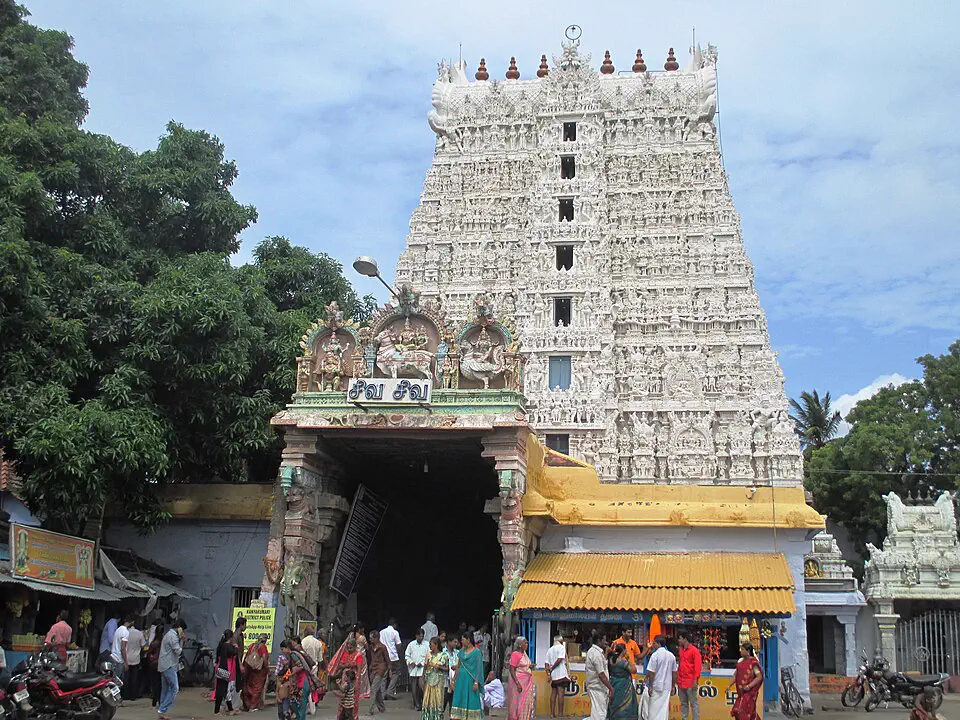
Begin with the gopuram, the tall entrance tower. Then notice the halls, carvings and worship spaces. The temple has links with both Shaiva and Vaishnava traditions, and its parts were built at different times.
Suchindram is about 7 km from Nagercoil and 12 km from Kanyakumari, beside the Pazhayar river. It is a living town with fields, streets and homes, not only a stop on the way to the cape.
Keep related journeys distinct
Sivalaya Ottam describes a district pilgrimage, while the temple’s own festival seasons organise worship in Suchindram. A relationship between traditions does not make every associated temple one of the circuit’s twelve shrines.
Nagercoil and the cape shore offer nearby context. Choose a route around current worship and access arrangements.
| Feature | What it helps explain |
|---|---|
| Dedication | The names associated with Shiva, Vishnu and Brahma |
| Halls and carvings | Different stages of building and craft |
| Festival streets | The connection between worship and town life |
Walk from the tower into a sequence of halls
The entrance tower provides the distant landmark, but the interior is a sequence of thresholds, pillared halls and subsidiary shrines. A mandapam is a hall, while a prakaram is a surrounding passage or enclosure. Those words help make sense of directions inside the temple and explain why a single photograph of the gopuram cannot represent the whole complex.
Tamil stone-building traditions sit alongside the region’s connections with Venad and Travancore. The visible result is a complex with several periods of work. Changes in carving, column form, roofing and the scale of an entrance can be read as clues to that accumulated history. An exact ruler-to-hall attribution needs an inscription or a reliable architectural record, rather than the assumption that all the features belong to one building campaign.
Hanuman, Vigneshwari and the ceiling above you
The large Hanuman image is one of the temple’s most recognisable features. The district also identifies Vigneshwari, a female form associated with Ganesha, and a representation of the Navagrahas on the ceiling. These invite three different kinds of looking: the scale of a freestanding image, the identity of an unusual deity form, and the arrangement of imagery overhead.
The government listing identifies shrines of Rama, Murugan and Sastha in the outer precinct. Together with the principal dedication, these explain why the temple is more than one sanctum. Allow time to notice how worshippers move between shrines. The individual figures should be identified from temple information or a knowledgeable guide; height estimates, an elaborate iconographic interpretation and the date of an image are separate matters.
Hanuman and the butter offering
Devotional descriptions of Suchindram include butter offerings to Hanuman, also called Anjaneya. Find My Temple’s account describes butter among offerings associated with the image’s raised tail. This is a worship practice; stories connecting it with cooling Hanuman after the burning of Lanka belong to religious interpretation rather than a documented date in the temple’s construction history.
For participation, ask the temple about its current arrangements and the offering’s local name. A published devotional description does not establish the current booking method, price or frequency. The image’s presence and the devotion around it can be understood without making claims about butter failing to melt or treating an offering as a medical remedy.
A temple town beside the Pazhayar
Suchindram’s position beside the Pazhayar connects the temple with the cultivated Nanjil Nadu plain. Water, fields, streets and the temple tank belong within the same town landscape, although each has its own history and management. The nearby wetland story follows how water also supports irrigation and bird habitat beyond the monumental precinct.
A visit can therefore have two parts: time within the permitted temple areas and a slower look at the town outside. Festival streets are everyday streets for much of the year. Shops, homes and people travelling through the town continue around the monument. The wetlands feature and the Pazhayar story explain those connections without making them additional shrines in the temple complex.
Architecture and cultural heritage
Read the architecture without touching it
The district identifies the Sthanumalayan dedication with Shiva, Vishnu and Brahma and places the temple beside the Pazhayar. Its visible parts belong to different phases of development.
The musical pillars are a reason to look carefully, not an invitation to strike the stone. Accounts disagree about sculpture and tower measurements; a useful visit does not depend on repeating an uncertain number.
Musical pillars: stone shaped for resonance
A lithophone is an instrument that produces sound through vibrating stone. The musical pillars at Suchindram are a celebrated example of the relationship between carving and acoustic behaviour. Slender elements within a carved column group can respond differently because geometry, material and the way the stone is supported affect vibration. Appreciating that principle does not require striking a protected pillar.
Detailed classifications of musical notes and stone properties require measurements of these particular pillars. Specific frequencies, mineral recipes and assertions that each column reproduces a named raga are therefore left out here. The useful observation is architectural: a pillar group combines structural presence, sculptural skill and a tradition of sound within the same hall.
Legends and local traditions
Religious and local accounts in this section are traditions, distinct from dated historical records.
Atri, Anasuya and the shared form of the deity
The district’s Tamil temple account associates the appearance of Thanumalayan with the prayers of the sage Atri and Anasuya. The wider sthala-purana tradition tells of the three deities and Anasuya’s devotion. This gives another entrance to the temple’s central idea: Shiva, Vishnu and Brahma are understood together in one sacred form. The name preserves that conjunction through Sthanu, Mal and Ayan.
The Indra-purification account explains the place through a different episode. These narratives answer religious questions about the sanctity of the site; inscriptions and building fabric answer historical questions about patronage and construction. Keeping those kinds of evidence distinct allows the traditions to retain their meaning without using them as dates for the surviving stone complex.
What makes this place unique?
The shared-deity tradition and the scale of the temple's carved spaces explain why Suchindram is more than a roadside stop.
Combine this with nearby places
Suchindram fits naturally between Nagercoil and Kanyakumari. Continue to Kumari Amman only if its separate opening session fits your travel time.
Responsible visiting
Do not tap the pillars or touch carvings. Follow current dress and photography rules.
Quick summary
Suchindram rewards an unhurried temple visit. Allow 1–2 hours as an editorial suggestion and check worship, dress and photography rules before arrival.
Sources for visitor information and transport
- HR&CE: Thanumalayan Temple visitor contact — Operating authority's published opening sessions and contact; no general admission price established.
- Kanniyakumari District: temples and living traditions — Named shrines and devotional traditions; legends are tradition, not independently established history.
- District administration: Sri Thanumalayan Swamy Temple — Destination-specific numbered routes and approach towns.
- District administration: Temples / Churches / Masjids — Suchindram's location between Nagercoil and Kanniyakumari.
- Southern Railway: Trivandrum Division station list (1 April 2022) — Station identities and codes only: Nagercoil Junction (NCJ), Nagercoil Town (NJT), Kanniyakumari (CAPE); not a current timetable or proof of the nearest station to each attraction.
Verification note
Editorial review: . Transport guidance follows the dated source record above; this is not a live timetable confirmation. Last verified for the explicitly sourced visitor details: 31 October 2026.
Historical references support the research passages they accompany. Editorial visit durations and recommendations are suggestions, not official operating information.