At a glance
- Location
- Padmanabhapuram, near Thuckalay
- Recommended time
- 2–3 hours for the palace
- Best for
- History enthusiasts, families and visitors interested in traditional timber architecture.
- Best time
- Start in the morning on an open day so that the midday break does not interrupt a hurried visit.
- Entry
- Admission ticket required; check the palace operator's current tariff and the day's opening before travelling.
- Walking
- Allow for stairs, thresholds and footwear rules; ask the operator about the route available to visitors with limited mobility.
Before you go: The palace closes on Mondays.
Visit durations are editorial planning suggestions. Allow extra time for travel, queues and your group’s pace.
Why visit Padmanabhapuram Palace?
- Thai Kottaram’s courtyard and carved timber
- Mantrashala and the polished black floors
- Uppirikka Malika, paintings and royal furnishings
How to reach
By bus
Use Thuckalay as the interchange for the palace. The district lists 313 and 350 from Nagercoil Vadasery via Thuckalay. Continue from Thuckalay by a separately arranged local transfer; do not assume these buses reach the palace gate. These are official published route listings, not live service confirmations. Confirm the destination board, boarding point, final stop and return service before travel.
By train
Eraniel (ERL), listed by Kerala Tourism about 6 km from the palace, is a nearby option if your train stops there. Nagercoil Junction (NCJ) is another arrival gateway. Arrange the road transfer separately.
By road
The palace is about 2 km east of Thuckalay. Confirm the palace visitor entrance and where your local transfer can stop.
Official route listings checked: . Kanniyakumari District Administration: Padmanabhapuram Palace; Kerala Tourism: Padmanabhapuram getting there.
District route table does not establish gate-side stops or a local onward service. Kerala Tourism pages disagree on the nearest-station label: older mobile page names Eraniel while campaign material names Nagercoil; use Eraniel as a nearby option and NCJ as a regional gateway, not an unsupported current train promise.
Visitor information
- Operator-published timings
- 09:00–12:30 and 14:00–16:30; closed Mondays. Last verified: 31 October 2026. The operator's holiday list is labelled 2024; confirm 2026 holiday closures directly.
- Operator-published entry tariff
- Indian adult ₹50; foreign adult ₹500; Indian child ₹10; foreign child ₹100. Last verified: 31 October 2026. Confirm age bands and current counter prices; camera charges are separate.
- Photography and mobility
- Check camera permissions, footwear rules and the accessible route with the operator before buying tickets.
Best time to visit
Start in the morning on an open day so that the midday break does not interrupt a hurried visit.
Check the palace’s current admission sessions, Monday closure arrangements and last entry before travelling. Confirm ticket and camera charges with the operator. Footwear removal, timber thresholds and stairs matter when planning mobility; ask about the accessible route.
Visitor information should be confirmed before travelling. Fees, permissions, facilities and last entry are not established unless explicitly sourced below.
Facilities, parking and accessibility
Confirm toilets, drinking water, parking, step-free access and assistance with the destination. A railway or bus arrival does not establish access to the entrance; plan any final walk or transfer for your group.
Earlier visitor notes
Background notes: current arrangements require confirmation. Use the dated official source record for the scope of verified details.
Take time to look
First look at the full layout. Then choose a few details, such as a carved pillar, doorway or change in floor level. Read the signs or ask a guide why each feature was made.
Before travelling, check the current opening times and photography rules. The palace has steps and uneven levels, so ask about help if anyone in your group has difficulty walking. Continue with our district history and personal itinerary builder.
What to see and do
- Begin with the entrance and courtyard rooms
- Follow the admitted route through audience spaces and timber interiors
- Add Udayagiri only if opening hours and road time allow
Important things to know before visiting
The palace closes on Mondays. Do not assume every room is open, and follow restrictions protecting floors, timber and painted surfaces.
Best way to experience this place
For families, choose a few memorable spaces such as the entrance, audience chamber and courtyards; leave time to look at the craftsmanship.
History and story behind the place
From Kalkulam to Padmanabhapuram
The palace began in the old royal centre of Kalkulam. Venad rulers developed it, and Marthanda Varma rebuilt and enlarged much of it in the eighteenth century. The name Padmanabhapuram honours Padmanabha Swamy, the deity of Travancore's royal family.
The royal court later moved to Thiruvananthapuram. In 1935, the palace became a museum open to the public. The buildings therefore belong to different periods and were not all built at the same time.
How the building works
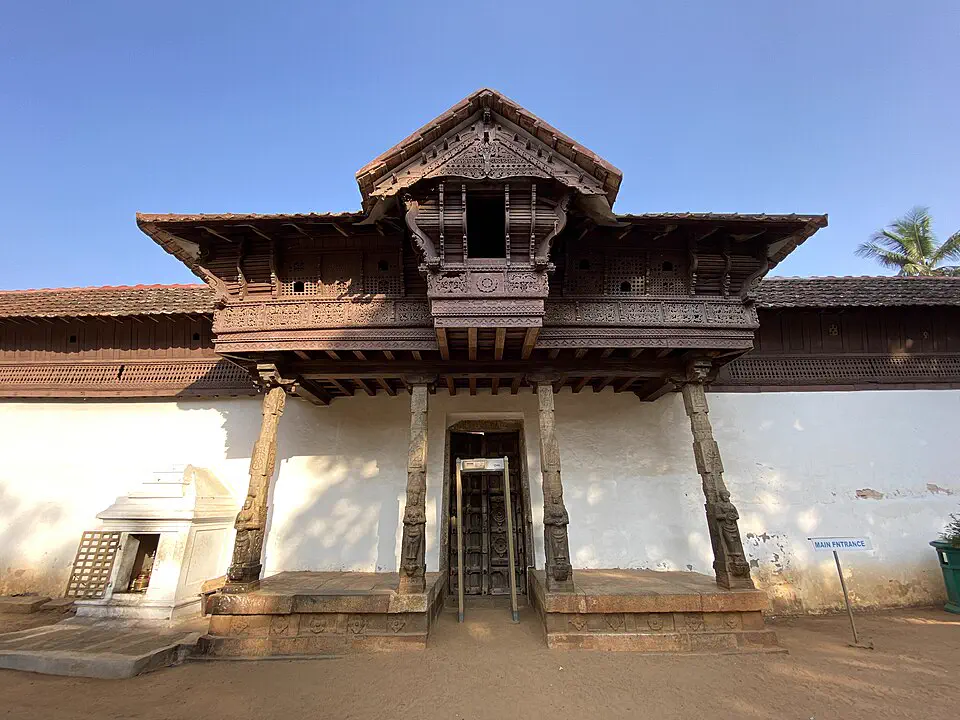
The palace is known for timber building methods and Taccusastra, a traditional system of design and construction. Its carved supports, screens, doors and ceilings are both useful and beautiful.
Notice how air and light enter the council chamber, how the courtyards connect the rooms, and how the stone Navarathri Mandapam differs from the wooden buildings. The craft is not only decoration; it helps the palace work well.
Our pride: The palace also records the skill of carpenters, masons, artists and today's care teams. Take time to notice their work.
A heritage that crosses today's border
The palace is in Kanyakumari district, Tamil Nadu, but the Government of Kerala maintains it. This unusual arrangement reflects the area's history before state borders changed in 1956.
It is on India's UNESCO Tentative List. This means it is being considered; it is not yet a UNESCO World Heritage Site.
What the UNESCO record means
India’s submission for Padmanabhapuram Palace entered the UNESCO Tentative List on 15 April 2014. Tentative-list inclusion is different from inscription on the World Heritage List.
The submission describes timber construction, tiled roofs, carved work and mural decoration. It also records Kerala Government custodianship after the 1956 state reorganisation. That administrative relationship does not move the palace geographically out of Tamil Nadu.
Thai Kottaram, dining halls and royal ceremony
Thai Kottaram is the older core around which the palace grew. Mantrasala belongs to the administrative and audience side of court life, while the Uttupura brings communal dining and hospitality into view. Large dining spaces required preparation, service and movement as well as room for guests. These buildings reveal a royal household sustained by cooks, attendants, craftspeople and administrators.
The Navarathri Mandapam introduces a different material and purpose. Its stone columns and performance setting contrast with the timber rooms around it. The palace’s continuing Navarathri connection follows the journey of Saraswathi towards Thiruvananthapuram, joined by deities from Suchindram and Kumaracoil. A hall that now forms part of a museum route can therefore also belong to a living ceremonial geography.
From a royal residence to a protected museum
The palace developed through successive Venad and Travancore rulers. The move of the royal centre to Thiruvananthapuram changed its administrative role, while ceremonial connections continued. Its later preservation as a museum made rooms designed for court and household life available to a different public. This history explains why the visitor encounters several periods within one coherent architectural setting.
The 1956 reorganisation placed the surrounding district in Tamil Nadu while Kerala retained custodianship of the palace. The heritage boundary and the state boundary therefore answer different questions. The complex remains physically in Tamil Nadu; its conservation is associated with Kerala’s Department of Archaeology. The district history follows the political sequence in more detail.
Architecture and cultural heritage
Know the main rooms
- Poomukham: the main entrance to the royal rooms.
- Mantrasala: the council room where the ruler and ministers met.
- Thai Kottaram: the oldest main part of the palace.
- Mani Meda: the clock tower, with detailed woodwork around its balcony.
- Navarathri Mandapam: a stone hall used for performances.
These rooms show how the palace was used for government, family life, timekeeping and the arts. Read the signs or ask a guide when a story about an object is unclear.
Rooms with different roles
The palace operator identifies Poomukhamalika as the main gateway, Mantrasala as the audience chamber, Mani Meda as the clock tower and Thai Kottaram as the palace core. Reading those functions gives the visit a sequence beyond taking photographs.
A room’s traditional material recipe or an object’s reputed medicinal quality should not be confused with tested chemical or therapeutic evidence.
| Space | Function identified by the operator |
|---|---|
| Poomukhamalika | Principal gateway |
| Mantrasala | Audience chamber |
| Mani Meda | Clock tower |
| Thai Kottaram | Core of the palace complex |
Why are the palace floors black and glossy?
The black, polished floor is a distinctive feature of Mantrasala, the audience chamber. The palace operator says its exact ingredients are unknown. Its account lists lime, burnt coconut shells, tender coconut water, sand and plant extracts as a traditional explanation of the mixture, rather than an established laboratory recipe.
Look at the floor together with the lotus-carved ceiling, ornamental chairs and broad bay window. These details belong to a room designed for royal meetings. The finish is part of the surviving interior; follow the museum route and instructions when viewing it.
Roofs, courtyards and the movement of air
Padmanabhapuram’s architecture responds to a wet tropical setting through a sequence of sheltered and open spaces. Tiled slopes shed rain, projecting eaves shelter edges, and courtyards bring daylight into a group of connected buildings. Screens and openings modify how light and air reach an interior. The relationship between these elements is more revealing than a claim that one traditional ingredient explains the comfort of the entire palace.
Timber construction also gives the visitor a visible structural vocabulary: posts carry beams, beams support roof members, and joints connect pieces with different jobs. Carving can appear on the same member that carries a load. Look at the transition from a column to the beam above it and then at the roof beyond. The craft is a coordinated building system, with maintenance as much a part of its survival as the original carpentry.
Uppirikka Malika and its painted upper rooms
The palace operator describes Uppirikka Malika as a building that combines a treasury, royal accommodation, meditation and a sacred upper storey. Its position and vertical arrangement give it a different character from the lower courtyard buildings. The upper room’s murals connect architecture with a painting tradition that includes religious narratives and the representation of people and their world.
An account of a room’s traditional function is not a promise that every floor is open during a visit. Museum circulation and conservation determine the public route. The operator and the UNESCO submission also differ on some dates and room descriptions, so this guide uses their shared architectural context rather than presenting one unqualified date for the whole multi-storeyed building.
The royal bed and its carved timber
The operator identifies three carved poster beds, or sapramancha kattil, in the bedrooms of Uppirikka Malika. The headboards and footboards combine Indian mythological and European decorative features. The king’s bed is traditionally described as combining 64 timber samples; that description should not be converted into 64 independently identified tree species.
The operator itself leaves the gift attribution open between Dutch and Portuguese donors. The number of timbers, the donor and the woods’ reputed medicinal character therefore remain attributed accounts. The furniture can be appreciated for its carving and cultural connections without a therapeutic claim. A separate sacred cot belongs to the restricted upper prayer room.
What makes this place unique?
The palace combines a large timber architectural complex with the political history of Travancore. It is in Tamil Nadu and maintained by Kerala's archaeology department.
Combine this with nearby places
Combine the palace with nearby Udayagiri Fort on the Thuckalay side of the district. Kumaracoil can fit if its worship session suits the same road outing.
Responsible visiting
Protect the black floors and carved wood. Keep hands off exhibits; medicinal-wood traditions do not establish medical benefits.
Quick summary
Padmanabhapuram Palace is best for a slower heritage visit. Allow 2–3 hours as an editorial suggestion, avoiding Monday and confirming holiday closures.
Sources and further reading
- Padmanabhapuram Palace operator: protected monument and building features
- UNESCO World Heritage Centre: India's Padmanabhapuram Palace tentative-list submission
- Padmanabhapuram Palace operator: architecture and named buildings
- Padmanabhapuram Palace operator: Uppirikka Malika and room functions
- Palace operator: Mantrashala, black floor and audience-chamber details
Sources for visitor information and transport
- Padmanabhapuram Palace: Department of Archaeology monument — Protected palace, timber architecture and named rooms; not a current admission tariff.
- Padmanabhapuram Palace operator: visiting time and entrance fee — Published visiting sessions, Monday closure and admission tariff checked 31 October 2026. The page's 2024 holiday list is not used as the current holiday calendar.
- Kanniyakumari District Administration: Padmanabhapuram Palace — Vadasery routes 313 and 350 through Thuckalay; palace location 2 km east of Thuckalay.
- Kerala Tourism: Padmanabhapuram getting there — Identifies Eraniyal/Eraniel as nearest railway station, approximately 6 km from the palace.
- Southern Railway: Thiruvananthapuram division station list — Station identities/codes NCJ, ERL and KZT only; not a current train timetable, last-mile distance survey or proof of nearest station.
Verification note
Editorial review: . Transport guidance follows the dated source record above; this is not a live timetable confirmation. Last verified for the explicitly sourced visitor details: 31 October 2026.
Historical references support the research passages they accompany. Editorial visit durations and recommendations are suggestions, not official operating information.