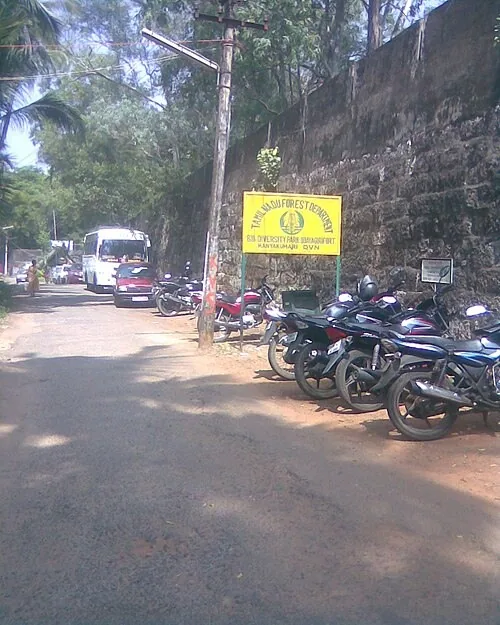

At a glance
- Location
- Puliyoorkurichi, near Padmanabhapuram
- Recommended time
- 1–2 hours
- Best for
- Families, military history and visitors combining the Thuckalay heritage sites.
- Best time
- A cooler dry morning within visiting hours makes the outdoor circuit more comfortable. Stop or shelter as directed during heavy rain or lightning.
- Entry
- Check the current entry ticket and which heritage and park areas are open. Visitor information should be confirmed before travelling.
- Walking
- Plan an outdoor walk with uneven sections; ask about the route and assistance suitable for your group.
Before you go: Follow Forest Department visitor rules and keep to marked paths.
Visit durations are editorial planning suggestions. Allow extra time for travel, queues and your group’s pace.
Why visit Udayagiri Fort and De Lannoy’s memorial?
- Travancore’s inland military landscape
- The garrison and foundry story
- De Lannoy’s chapel and burial association
How to reach
By bus
The district lists 303 from Nagercoil Vadasery via Parvathipuram and Villukuri for Udayagiri Fort; its Anna bus stand row lists 11L, 13N and 13J via the same towns. Confirm the Puliyoorkurichi drop-off and arrange the final entrance approach. These are official published route listings, not live service confirmations. Confirm the destination board, boarding point, final stop and return service before travel.
By train
Nagercoil Junction (NCJ) is a regional railway gateway; arrange a separate road transfer. Check your train's stopping station and travel-date timetable.
By road
Use Puliyoorkurichi / Udayagiri Fort as the destination when arranging road travel in the Thuckalay palace region. The fort and Padmanabhapuram Palace have separate entrances.
Official route listings checked: . Kanniyakumari District Administration: Udayagiri Fort.
No exact stop, walking distance, parking or timetable verified. The official table's broad '313 Sector' label is not a usable individual bus number and was excluded.
Visitor information
- Published timings
- The district administration lists 09:30–17:30. Last verified: 31 October 2026. Confirm last entry and temporary closures.
- Tickets and facilities
- Check current admission, toilets, parking and mobility assistance with the site. Listings of park attractions do not guarantee every facility is operating. Visitor information should be confirmed before travelling.
Best time to visit
A cooler dry morning within visiting hours makes the outdoor circuit more comfortable. Stop or shelter as directed during heavy rain or lightning.
Allow daylight and walking time through the admitted grounds. Confirm current facilities and mobility arrangements rather than assuming a fully accessible circuit. The garrison, foundry story and memorial area introduce different parts of the fort’s history.
Visitor information should be confirmed before travelling. Fees, permissions, facilities and last entry are not established unless explicitly sourced below.
Facilities, parking and accessibility
Confirm toilets, drinking water, parking, step-free access and assistance with the destination. A railway or bus arrival does not establish access to the entrance; plan any final walk or transfer for your group.
What to see and do
- Begin with the admitted fort-ground route
- Look for the documented memorial and military context
- Combine with the palace only within both sites’ current admission windows
Important things to know before visiting
Follow Forest Department visitor rules and keep to marked paths. Do not feed animals or enter closed historic structures.
Best way to experience this place
For families, focus on the fort setting and De Lannoy memorial before adding any park activities that are operating that day.
History and story behind the place
A different kind of fort visit
Udayagiri is an inland stop, distinct from the coastal outlook at Vattakottai. Read its enclosure and setting as part of a wider network rather than expecting every fort to have the same plan or purpose.
The Ministry of Tourism’s account connects the fort with De Lannoy and the aftermath of the Battle of Colachel. Those connections provide a firmer starting point than stories of a continuous tunnel between monuments.
From Colachel to service in Travancore
Udayagiri's best-documented human connection is Eustachius De Lannoy. The Ministry of Tourism places his later Travancore service in the aftermath of the Battle of Colachel in 1741, when Marthanda Varma defeated the Dutch East India Company's forces. A captured European officer entering the service of the victorious Indian ruler reverses a familiar colonial storyline. Here military knowledge circulated through a relationship shaped by Travancore's victory and the ruler's subsequent decisions.
Tamil Nadu's Department of Archaeology records the reconstruction of Udayagiri in granite in 1744 under De Lannoy. That provides a firm architectural point within the years following Colachel. A fort associated with his Travancore service stands within the region of the royal capital at Padmanabhapuram, tying military reorganisation to the practical geography of the kingdom. Colachel explains the coastal conflict; the fort supplies the next chapter in the officer's regional life.
Reading an enclosure built for more than display
A fort is a working system of boundaries, entrances, internal ground and positions from which the surroundings can be observed. Udayagiri's substantial enclosure invites that kind of reading. Consider how the walls relate to the local terrain and how moving through the entrance changes the view. The landscape within and around a fort is part of its design, so the most informative photograph may include ground level and a length of wall rather than only an isolated stone detail.
The garrison and military-production history gives the enclosure an everyday dimension. Soldiers needed equipment, storage, training space and supplies as well as defensive walls. The district's account identifies an old foundry used to cast cannonballs, bringing skilled production within the story of defence. Such work required people and material resources: it connects the monumental perimeter with the labour that kept a military establishment operating.
The family graves and the scale of an individual life
The Ministry of Tourism identifies De Lannoy's grave within the fort, together with those of his wife and son. That family grouping shifts the visit from the scale of a kingdom to the scale of a household. An officer who entered the story through warfare also lived a life in the region, and the memorial setting records that longer connection. The graves are historical objects with their own material and inscriptional evidence, as well as places deserving quiet attention.
If inscriptions can be read from the permitted visitor area, look for what they actually record: a name, relationship, date or account of service. A memorial text has a purpose and a point of view; it commemorates a person rather than providing a neutral history of the entire period. It can be read alongside the district's account of the fort and the broader history of Travancore to distinguish personal remembrance from the later public story of military achievement.
Palace, port and fort as three connected histories
Udayagiri makes particular sense in company with Padmanabhapuram Palace. The palace gives access to courtly and domestic spaces, ceremonial halls and the architecture of royal administration; the fort turns attention towards defence and service. Add Colachel's coastal setting and the regional story becomes easier to follow. These places need not all be visited in one crowded day, but understanding their relationships helps each stop retain its purpose.
The connection can be extended to Vattakottai, where the coastline becomes the central feature of a defensive setting. The difference in landscape is instructive: Udayagiri is approached within the inland royal region, while Vattakottai is experienced against the open sea. People, political authority and the practical geography of the kingdom connect them. Visiting both gives the Travancore story a tangible scale, from royal residence to military enclosure and coastal outlook.
Colachel and later service
The government tourism account dates the Battle of Colachel to 1741 and links De Lannoy’s later work for Travancore with Udayagiri. The Colachel guide keeps that battle context together.
A change of service can connect two places without explaining every wall and structure at either one. Construction phases and the function of a particular building require their own evidence.
The memorial inside the fort
The official account identifies the graves of De Lannoy, his wife and his son within Udayagiri. Read a memorial as a record with names, language and commemorative purpose.
Where inscriptions are accessible, take time to observe them without touching their surfaces. A family memorial can tell a more precise story than a broad claim about a whole military era.
The foundry connects fortification with skilled production
The foundry history makes Udayagiri more than a perimeter and a memorial. Military equipment had to be made, maintained and supplied. The district’s reference to cannonball production points towards metalworking, fuel, transport and organised labour within the same military landscape as the garrison. A workshop function also explains why open ground and internal spaces matter alongside the defensive wall.
The recorded 1744 granite reconstruction belongs after the 1741 Colachel conflict. Keeping those events in order helps distinguish a battle from the subsequent work of reorganising Travancore’s defences. De Lannoy’s family graves then extend the account beyond technical service into life and commemoration in the region. Colachel, Udayagiri and Padmanabhapuram provide three different bodies of evidence for that connected history.
Build a realistic heritage day
Padmanabhapuram Palace offers a related royal setting, while Vattakottai turns attention back towards the sea. Choose the combination that fits the available day and current opening arrangements.
Follow site notices about public areas and access. Memorials and heritage enclosures deserve the same care even when the surrounding landscape feels informal.
What makes this place unique?
The site connects Travancore's military history with the life of a European commander in local service, within a much larger fortified landscape.
Combine this with nearby places
Pair Udayagiri with Padmanabhapuram Palace near Thuckalay. Check the palace's Monday closure before choosing the day.
Responsible visiting
Respect the chapel and burial area. Keep away from restricted structures and do not pursue tunnel stories as access directions.
Quick summary
Udayagiri works well as part of a Thuckalay heritage outing. Allow 1–2 hours as an editorial suggestion and confirm the current visitor circuit.
Sources for visitor information and transport
- Kanniyakumari District: Udayagiri Fort — Fort setting, De Lannoy tombs, Forest Department management and published 09:30–17:30 hours.
- Kanniyakumari District Administration: Udayagiri Fort — Vadasery 303 and Anna-stand 11L/13N/13J via Parvathipuram/Villukuri.
- Southern Railway: Thiruvananthapuram division station list — Station identities/codes NCJ, ERL and KZT only; not a current train timetable, last-mile distance survey or proof of nearest station.
Verification note
Editorial review: . Transport guidance follows the dated source record above; this is not a live timetable confirmation. Last verified for the explicitly sourced visitor details: 31 October 2026.
Historical references support the research passages they accompany. Editorial visit durations and recommendations are suggestions, not official operating information.