
At a glance
- Location
- Southern mainland shore of Kanyakumari town
- Recommended time
- 45–90 minutes for the shore and nearby views
- Best for
- Pilgrims, first-time cape visitors and families choosing a mainland outing.
- Best time
- Choose daylight for a first visit. Sunrise adds a sky-watching experience when cloud and horizon conditions allow.
- Entry
- Confirm the public approach and any local restrictions or ritual arrangements. Visitor information should be confirmed before travelling.
- Walking
- Use established seafront routes. Steps and shoreline surfaces may be wet or crowded; ask about the most suitable approach for limited mobility.
Before you go: Treat the sea with caution and do not enter the water on the strength of a religious tradition or a calm appearance.
Visit durations are editorial planning suggestions. Allow extra time for travel, queues and your group’s pace.
Why visit Triveni Sangamam?
- The cape’s meeting-of-the-seas identity
- A living shore used for ancestral rites
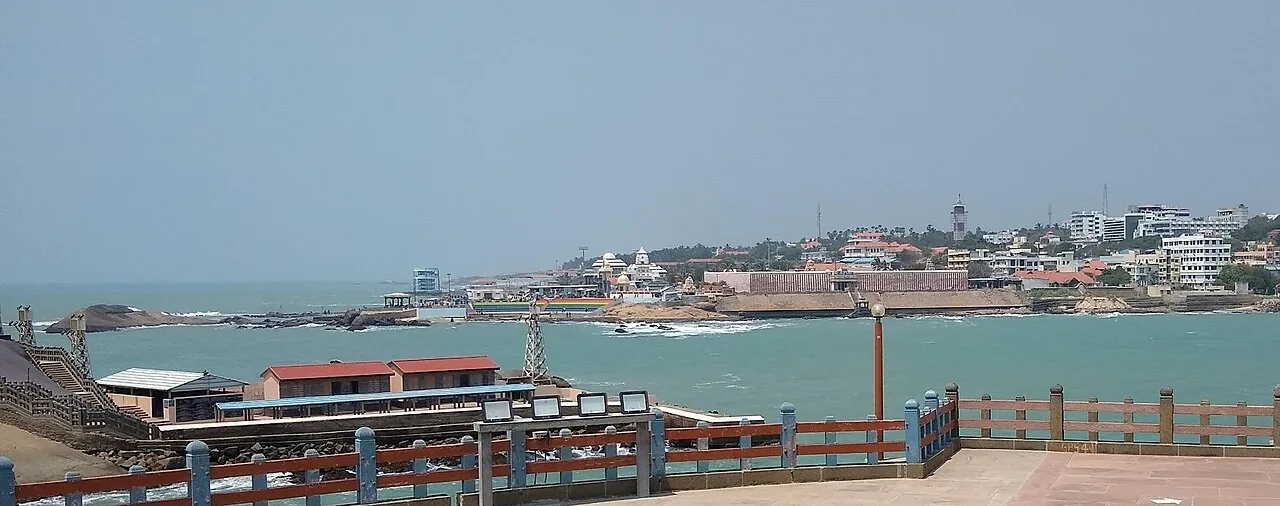
- Views of the offshore monuments and nearby mainland memorials
How to reach
By bus
The district sunrise/Triveni Sangam page lists 1, 2 and 303 from Anna Bus Stand via Suchindram and Kottaram, plus 303 from Marthandam and Kaliyakkavilai. Continue from Kanniyakumari town to the permitted mainland shoreline approach.
By train
Kanniyakumari railway station (CAPE) is the town's rail arrival point; Nagercoil Junction (NCJ) is an alternative requiring a separate road connection. Check your train's actual stopping station and date in Indian Railways enquiries, then arrange the final transfer.
By road
Sangamam is a mainland shore visit. Use the pedestrian approach permitted by local crowd controls; an offshore ferry is a separate journey.
Official route listings checked: . District administration: Sun Rise Point – Kanniyakumari.
Checked the official web listing on 31 October 2026. This confirms what the authority publishes, not live operation. No departure times, frequency, fare or guaranteed return service verified. Confirm the destination, alighting stop and return service with bus staff. Vadasery 304 is omitted because district pages disagree. Shore access, crowd-control drop-offs and walking distance were not verified.
Visitor information
- Shore access
- Visitor information should be confirmed before travelling.
- Sea and rituals
- Ask local officials about the permitted public areas and any ritual-related restrictions. No safe bathing area or continuous lifeguard coverage is established here.
Best time to visit
Choose daylight for a first visit. Sunrise adds a sky-watching experience when cloud and horizon conditions allow.
Observe the shore without expecting three permanently separated water colours. Give ancestral rites privacy and follow barriers. Reinforced steps or chains do not establish that sea entry is safe; follow current local restrictions.
Visitor information should be confirmed before travelling. Fees, permissions, facilities and last entry are not established unless explicitly sourced below.
Facilities, parking and accessibility
Confirm toilets, drinking water, parking, step-free access and assistance with the destination. A railway or bus arrival does not establish access to the entrance; plan any final walk or transfer for your group.
What to see and do
- Begin at a permitted shore viewpoint
- Allow quiet space around rituals and memorial visits
- Choose either an offshore trip or an unhurried mainland walk according to actual operating conditions
Important things to know before visiting
Treat the sea with caution and do not enter the water on the strength of a religious tradition or a calm appearance. Keep clear of wet rocks and waves.
Best way to experience this place
For families, combine a brief shore visit with one nearby mainland landmark and keep children away from the water's edge.
History and story behind the place
Understand the meeting of the seas
The traditional description connects the Arabian Sea, the Bay of Bengal and the Indian Ocean at Kanyakumari. It is a way to understand the cape’s geography and cultural meaning; a visitor should not expect three permanent coloured boundaries visible in the surf.
Water appearance changes with light, sediment, waves and viewing conditions. A photograph of contrasting colours is not, on its own, a measurement identifying three different water masses.
Temple, memorials and the view from the mainland
The mainland shore brings several histories into one view. Kumari Amman Temple anchors the older devotional landscape; the offshore rock is associated with Vivekananda's commemoration; the Thiruvalluvar Statue gives the Tamil poet and the Thirukkural a monumental presence. The memorials are modern structures with their own building histories. Seeing them together is one of the cape's defining experiences, but their proximity does not make them parts of a single historical episode.
The shore also lets visitors understand the relationship between the mainland and offshore attractions before choosing whether to take a ferry. The rocks, landing area and weather remain visible parts of the journey. A meaningful cape visit can include time on land for the temple precinct, the sea and the memorial view, alongside a separate decision about the boat trip. The Vivekananda Rock Memorial guide and the statue guide explain those sites in their own right.
Dawn, evening and a changing horizon
Sunrise, sunset and full-moon viewing give the cape different moods. These are different astronomical events, and the useful viewing direction changes with the season. An open outlook does not guarantee a clear horizon: low cloud can hide the Sun while the rest of the sky becomes bright and colourful. The experience may be strongest in changing light across people, buildings and water rather than the brief moment of the solar disc crossing the horizon.
Full-moon dates can offer the prospect of a rising Moon around the time the Sun sets, but exact alignment, timing and visibility depend on date and location. The phrase 'three seas meet' should not be used to promise a simultaneous spectacle every evening. Return to the shore at different times if the trip permits. The contrast between a quiet interval, a busy dawn and an evening gathering can reveal as much about the cape's public life as a single successful photograph.
Kamaraj Memorial: another chapter of public memory
Kamaraj Memorial honours the freedom fighter and former Tamil Nadu Chief Minister K. Kamaraj. The district administration connects the site with public homage to his ashes before immersion in the sea, and identifies a library within the memorial. His association with education adds a different civic theme to the cape’s commemorative landscape.
Gandhi Mandapam and Kamaraj Memorial are mainland stops. They can be considered alongside the sacred shore without a ferry journey. Their separate histories also explain why a cape walk can include worship, literature, national commemoration and state political history within a small area.
Guganathaswamy: a Chola-period temple beyond the seafront
Guganathaswamy Temple gives a cape visit a further architectural stop away from the immediate sacred shore. The district lists it near the railway station, associates its construction with Rajaraja Chola and identifies eleventh-century inscriptions. Its stone architecture offers a different historical setting from the modern offshore memorials.
The district’s broader temple account records inscriptions dated 1038, 1044 and 1045. These are dates attached to surviving records, rather than proof that every part of the building was constructed in one of those years. Ask for the temple by its full name when planning a visit; the region has several stations and similarly transliterated shrine names.
Architecture and cultural heritage
Gandhi Mandapam and remembrance on the mainland
Gandhi Mandapam commemorates the occasion when an urn containing Gandhi’s ashes was placed here for public homage before immersion in 1948. The district administration dates completion of the memorial to 1956. Its purpose is therefore distinct from the goddess temple, the rock memorial and the monument to Thiruvalluvar.
The district account also describes a roof opening intended to illuminate the memorial pedestal at midday on 2 October. Read this as a feature of the building’s commemorative design. Cloud, access and observation conditions determine what a visitor can see on the day; a visit can focus on the memorial’s history at any time of year.
Geography, water and local life
Why the meeting of waters is a sacred place
Triveni Sangamam is understood by pilgrims as the meeting of the Arabian Sea, Bay of Bengal and Indian Ocean at the cape. Sangamam means a confluence or coming together; here the word connects geography with religious meaning. The shore is a place where visitors arrive at a land's end, while devotees may understand the same arrival through purification, offerings and the presence of Kumari Amman. These experiences share a location without having to share the same purpose.
For many pilgrims, the shore is associated with ritual bathing and remembrance of ancestors. These practices express relationships between the living and the dead, the pilgrim and a sacred landscape, and an individual journey and a wider tradition. A family's observance may look very different from the sightseeing taking place a short distance away. That coexistence is part of Triveni Sangamam's character: it is both a visited landmark and a place in which deeply personal religious acts continue.
What a change in water colour can tell you
Visitors often arrive expecting three permanent colours or clearly separated strips of water. The sea does not maintain a visible boundary like a line on a map. Surface colour changes with light, cloud, depth, suspended sediment and wave conditions. Darker and paler areas can move or disappear as those conditions change. The sense of three adjoining marine regions is geographical and cultural; a photograph of three colours is not needed to validate the visit.
The shore is still an excellent place to look closely at moving water. Compare the surface beyond the breaking waves with the foam and stirred sediment close to the rocks. Watch how cloud shadow changes a patch of sea, then how the same water appears when sunlight returns. The sunrise, sunset and moonrise guide explains why the cape's light, wind and seasonal weather produce different experiences rather than a guaranteed daily spectacle.
A shore used for sacred observance
The coastal precinct is associated with ancestral rites and other acts of devotion. Treat those activities as worship, allowing privacy and space rather than positioning them as a performance for visitors.
Kumari Amman Temple provides the neighbouring goddess tradition. The temple’s nose-ring account belongs with that shrine; it should not become a scientific explanation of the sea.
Read the landmarks from the shore
The Vivekananda Rock Memorial and Thiruvalluvar Statue give the offshore view its familiar form. Looking from the mainland and visiting the rocks are separate experiences.
Follow the operator’s current arrangements for the offshore journey. A landmark’s visibility does not mean boats are operating or that every adjoining walkway is open.
One shore, several kinds of remembrance
Kumari Amman’s sacred geography, the ancestor rites at the shore, Vivekananda’s remembered meditation and the literary commemoration of Thiruvalluvar give the cape several meanings. They share a view without being one historical event. Gandhi Mandapam adds another modern commemorative setting on the mainland.
A walk can follow those differences: begin with the temple and sacred shore, look towards the rock for the meditation-and-memorial story, then towards the statue for its relationship with the Tirukkural. The sea provides the common setting. It does not need three permanent colours or a scientifically visible line of separation to explain why the cape became such an important place of pilgrimage and public memory.
Light weather and a public approach
For a dawn, dusk or full-moon visit, read the sky-viewing guide. Direction and date matter alongside the weather; a simultaneous sun-and-moon spectacle should never be promised.
Stay within authorised public areas and respond to local instructions at the water’s edge. Sacred significance does not remove coastal hazards, and a defined set of steps is not a guarantee that entering the sea is safe.
What makes this place unique?
The sacred meeting-of-seas tradition gives the cape cultural meaning; visitors should not expect fixed visible boundaries between differently coloured seas.
Combine this with nearby places
Combine with Kumari Amman Temple and Gandhi Memorial on a mainland circuit, checking each building's opening session separately.
Responsible visiting
Stay out of rough water and give ceremonies privacy. Keep offerings and packaging out of the sea.
Quick summary
Triveni Sangamam is best for understanding the sacred cape from shore. Allow 45–90 minutes as an editorial suggestion and follow the day's sea and crowd warnings.
Sources and further reading
- Kanniyakumari District: temples and living traditions
- District administration: Vivekananda and Shripada Mandapams
- Ministry of Tourism: Kanniyakumari's shore and pilgrimage traditions
- District administration: Mahatma Gandhi Mandap, ashes and memorial design
- District administration: Kamaraj Memorial and library
- District administration: Guganatha Swamy Temple
Sources for visitor information and transport
- Ministry of Tourism: Kanniyakumari — Cape destination and its seafront religious and memorial setting; not swimming safety.
- Kanniyakumari District: temples and living traditions — Named shrines and devotional traditions; legends are tradition, not independently established history.
- District administration: Sun Rise Point – Kanniyakumari — Identifies the sunrise shore with Triveni Sangam and provides Anna / western-town bus listings.
- Southern Railway: Trivandrum Division station list (1 April 2022) — Station identities and codes only: Nagercoil Junction (NCJ), Nagercoil Town (NJT), Kanniyakumari (CAPE); not a current timetable or proof of the nearest station to each attraction.
Verification note
Editorial review: . Transport guidance follows the dated source record above; this is not a live timetable confirmation. Current opening hours, fees and permissions have not been independently verified.
Historical references support the research passages they accompany. Editorial visit durations and recommendations are suggestions, not official operating information.