At a glance
- Location
- Offshore from Kanyakumari town
- Recommended time
- 2–3 hours including a flexible ferry allowance
- Best for
- First-time cape visitors, pilgrims and visitors interested in Vivekananda.
- Best time
- Choose a day with favourable sea conditions and keep the mainland part of your itinerary flexible if sailings are delayed or suspended.
- Entry
- A ferry journey and monument admission involve separate arrangements. Use the official ferry service and confirm what your ticket includes.
- Walking
- Allow for ferry boarding, steps and standing in queues. Confirm assistance and the boarding route if anyone has limited mobility.
Before you go: Follow crew instructions and wear the supplied safety equipment as directed.
Visit durations are editorial planning suggestions. Allow extra time for travel, queues and your group’s pace.
Why visit Vivekananda Rock Memorial?
- Vivekananda Mandapam
- Shripada Mandapam and the older sacred association of the rock
- The meditation hall and offshore setting
More context for the highlights
Background notes: current arrangements require confirmation. Use the dated official source record for the scope of verified details.
Why visit
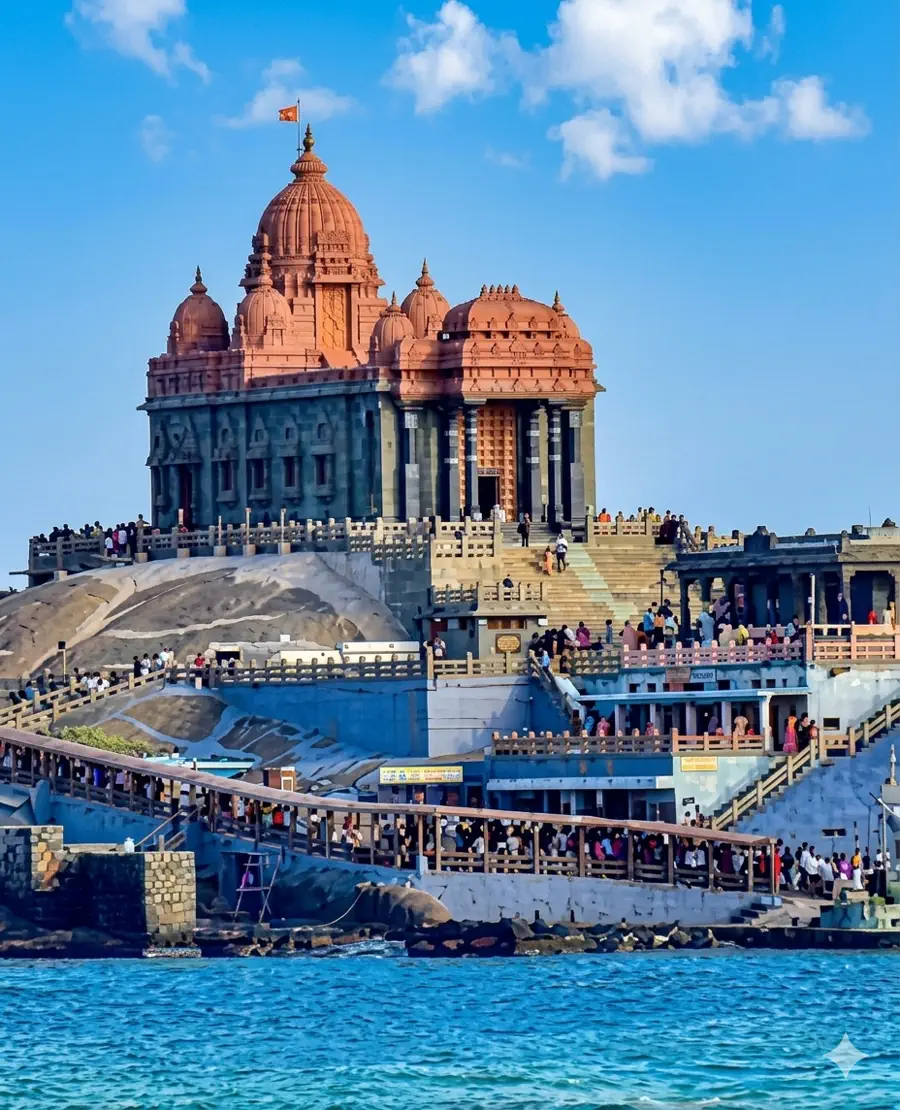
The memorial stands on a rock in the sea where Swami Vivekananda is believed to have meditated in December 1892. It has two main halls: Vivekananda Mandapam and Shripada Mandapam. Both offer wide views of the sea and Kanyakumari.
How to reach
By bus
For the mainland leg, the official memorial page lists 1, 2 and 303 from Nagercoil via Suchindram and Kottaram, and 303 from Marthandam or Kaliyakkavilai via Thuckalay and Nagercoil. Continue from Kanniyakumari's bus terminal to the authorised ferry embarkation area.
By train
Kanniyakumari railway station (CAPE) is the town's rail arrival point; Nagercoil Junction (NCJ) is an alternative requiring a separate road connection. Check your train's actual stopping station and date in Indian Railways enquiries, then arrange the final transfer.
By road
Road transport reaches the mainland ferry area. An authorised boat journey is needed for the offshore memorial; confirm sailing and return instructions with the ferry operator.
Official route listings checked: . District administration: Vivekananda Rock Memorial; District administration: How to Reach.
Checked the official web listing on 31 October 2026. This confirms what the authority publishes, not live operation. No departure times, frequency, fare or guaranteed return service verified. Confirm the destination, alighting stop and return service with bus staff.
Approach and travel context
Background notes: current arrangements require confirmation. Use the dated official source record for the scope of verified details.
How to reach it
Walk to the ferry terminal near the Kanyakumari seafront. Visitors normally reach the memorial by boat. Queues are usually shorter soon after opening. Ferry trips may stop when the sea is rough or the wind is strong.
Allow for the complete offshore journey
The time-consuming part of an offshore visit may be waiting to board rather than travelling on the boat. Treat the queue, outward crossing, time in the halls and return boarding as one visit. A mainland walk afterwards is easier to adjust than a fixed onward departure.
For a mixed-age group, discuss ferry boarding, steps and exposed walking before joining the queue. Ask staff about current assistance and which parts of the route are open. The old published fee or timetable on a tourism listing should not be treated as a live operator notice. Use the itinerary planner to leave a flexible mainland alternative around the offshore stop.
Visitor information
- Ferry booking
- The official Poompuhar portal offers online booking. Its terms require matching government ID and arrival at least 30 minutes before the booked departure. Last verified: 31 October 2026.
- Hours, admission and sea conditions
- Check the current sailing slots, separate memorial admission and return arrangements with the operator. Visitor information should be confirmed before travelling.
Best time to visit
Choose a day with favourable sea conditions and keep the mainland part of your itinerary flexible if sailings are delayed or suspended.
Confirm sailing, last boarding and return arrangements with the operator. Allow extra time for queues and sea-related suspensions. Keep a mainland alternative available and avoid a tightly timed onward connection.
Visitor information should be confirmed before travelling. Fees, permissions, facilities and last entry are not established unless explicitly sourced below.
Facilities, parking and accessibility
Confirm toilets, drinking water, parking, step-free access and assistance with the destination. A railway or bus arrival does not establish access to the entrance; plan any final walk or transfer for your group.
Earlier visitor notes
Background notes: current arrangements require confirmation. Use the dated official source record for the scope of verified details.
Steps, walking and comfort
The trip includes boarding a ferry, walking in the sun and climbing steps. The boat may move with the waves. People who find walking or steps difficult should ask about help at the terminal before buying tickets. Carry water, use sun protection and wear footwear with a good grip.
Quick facts
- Location
- Off the Kanyakumari seafront
- Access
- Public ferry
- Plan for
- 2–3 hours
- Best strategy
- Arrive early
- Official listed hours
- 8:00 am–4:00 pm; verify locally
What to see and do
- Confirm sailing and return arrangements at the shore
- Visit the two memorial halls by the admitted route
- Add the statue connection only when staff confirm access
More ideas for your visit
Background notes: current arrangements require confirmation. Use the dated official source record for the scope of verified details.
Plan your visit
- Reach the ferry terminal early and buy the available ticket.
- Follow staff instructions for life jackets and boarding.
- Visit the main memorial halls and meditation areas quietly.
- If the glass bridge is open, follow staff directions to the Thiruvalluvar Statue.
- Return to shore and walk to Gandhi Mandapam, the temple area or the sunset viewpoint.
Important things to know before visiting
Follow crew instructions and wear the supplied safety equipment as directed. Rough weather or operational decisions can prevent the crossing.
Best way to experience this place
For families, make this the main activity of a half-day outing, carrying water and leaving room for queues and a seated break afterwards.
History and story behind the place
From a meditation to a national memorial
Vivekananda Kendra records that Swami Vivekananda meditated here from 25 to 27 December 1892. President V. V. Giri opened the memorial on 2 September 1970. Eknath Ranade led the nationwide effort to build it. The visit and the building of the memorial happened many years apart.
Different records give different days for the meditation, but they place the visit in December 1892.
Notice how a memorial is used
A commemorative building organises movement and attention through entrances, halls and spaces for reflection. Give other visitors room to use those spaces quietly.
The neighbouring Amman temple has its own sacred traditions. A geographical connection between the rocks and the shore does not make their different histories interchangeable.
Understand the halls before joining the visitor route
The Vivekananda Mandapam includes gathering and meditation spaces. Sabha Mandapam names the assembly hall, while Dhyana Mandapam identifies the space for meditation. Shripada Mandapam has its own enclosure around the footprint-like projection associated by tradition with the goddess. These functions explain why visitors may move through one part of the memorial as sightseers and sit quietly in another.
The arrangement connects two kinds of remembrance: Vivekananda’s visit to the rock in December 1892 and an older devotional understanding of Sripada Parai. The modern halls do not date from the monk’s visit. Their construction created a public commemorative setting around a place that already carried sacred meaning.
Architecture and cultural heritage
Two halls, two kinds of memory
The Vivekananda Mandapam has halls for gathering and meditation. The Shripada Mandapam honours a footprint-like mark linked by local belief to Goddess Kanyakumari. This story about the goddess is a religious tradition; the modern memorial has its own recorded history.
For local people, this is more than a monument in the sea. An old sacred place later became part of India's national memory and a quiet space for prayer and reflection.
Building a memorial beyond the shoreline
The 1970 opening belongs to a different chapter from the 1892 meditation. The memorial required a sustained building campaign led by Eknath Ranade and work at a site separated from the mainland. Materials, workers and visitors all had to cross that stretch of sea. The resulting architecture combines a monumental public presence with rooms intended for reflection.
From the mainland, the whole building reads as a silhouette; from the landing, its platforms, stairways and halls become a sequence of spaces. Notice how that change of scale affects the experience. A shore view is also a worthwhile way to understand the memorial when an offshore visit is impractical. The neighbouring Thiruvalluvar Statue has a separate literary purpose, even though the two monuments now share a connected visitor journey.
Geography, water and local life
A shore view and an offshore visit
Looking towards the memorial from Triveni Sangamam and reaching it by boat are different experiences. Weather and the operator’s arrangements determine the journey.
Group the memorial with the Thiruvalluvar Statue only when the relevant access is operating. Leave room for waiting, walking and the return rather than treating the offshore group as a fixed-duration stop.
What makes this place unique?
The offshore setting connects a memorial to Vivekananda's 1892 visit with the older Shripada religious tradition; these are distinct strands of the site's story.
Combine this with nearby places
Combine with the Thiruvalluvar Statue only when the operator confirms the permitted connection. Gandhi Memorial is a useful mainland stop after the return.
Responsible visiting
Use authorised boats and crew instructions. Do not copy the historic swim narrative as a visitor activity.
Quick summary
The Rock Memorial suits visitors comfortable with a ferry outing. Allow 2–3 hours including queues as an editorial suggestion, and confirm service and tickets before committing.
Sources and further reading
Sources for visitor information and transport
- Kanniyakumari District: Vivekananda Rock Memorial — Named memorial halls and December 1892 association. Its 2018 ferry tariff is not used as a current price.
- Poompuhar Shipping Corporation: Kanniyakumari Ferry Service — Official online ferry booking, matching government ID and arrival at least 30 minutes before booked departure; not guaranteed sailings.
- District administration: Vivekananda Rock Memorial — Destination bus numbers and separate official ferry booking link.
- District administration: How to Reach — Nagercoil has Vadasery for mofussil routes and Anna Bus Stand for local routes; Nagercoil and Kanniyakumari are rail arrival hubs. No individual numbered bus service verified by this general page.
- Southern Railway: Trivandrum Division station list (1 April 2022) — Station identities and codes only: Nagercoil Junction (NCJ), Nagercoil Town (NJT), Kanniyakumari (CAPE); not a current timetable or proof of the nearest station to each attraction.
Verification note
Editorial review: . Transport guidance follows the dated source record above; this is not a live timetable confirmation. Last verified for the explicitly sourced visitor details: 31 October 2026.
Historical references support the research passages they accompany. Editorial visit durations and recommendations are suggestions, not official operating information.