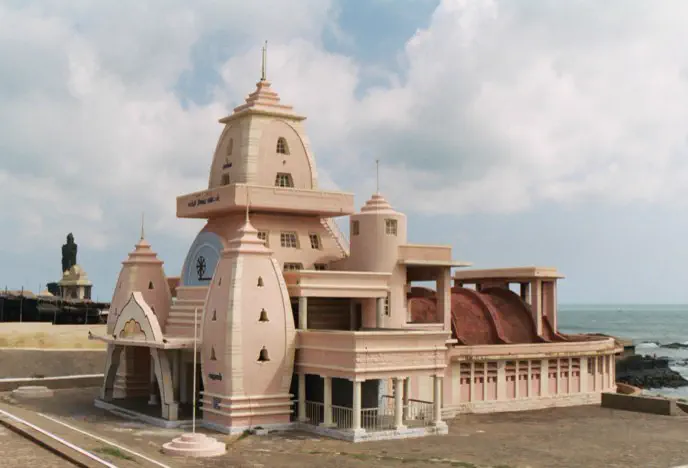
At a glance
- Location
- Mainland seafront, Kanyakumari town
- Recommended time
- 30–45 minutes
- Best for
- Families, modern Indian history and visitors seeking a short mainland stop.
- Best time
- Choose a confirmed opening hour and give the memorial a little time away from a rushed seafront circuit.
- Entry
- Check the memorial's current admission and visitor instructions. Visitor information should be confirmed before travelling.
- Walking
- Allow for footwear instructions, thresholds and any permitted upper-level route; ask about assistance if needed.
Before you go: Respect the commemorative space and photography rules.
Visit durations are editorial planning suggestions. Allow extra time for travel, queues and your group’s pace.
Why visit Gandhi Memorial?
- The place associated with public homage to Gandhi’s ashes
- The memorial’s central space
- The roof-opening tradition linking light and 2 October
How to reach
By bus
The Gandhi page consistently lists 1 and 2 from Nagercoil and 303 from Marthandam or Kaliyakkavilai via Thuckalay and Nagercoil. It inconsistently prints 305 at Vadasery and 304 at Anna, so those numbers are omitted. Reach Kanniyakumari town and continue to the memorial.
By train
The district's Gandhi visitor page identifies Kanniyakumari railway station as the nearest rail arrival point, with an onward auto or taxi journey. Check the travel-date train service before booking.
By road
The official visitor page places Gandhi Memorial about 19 km by road from Nagercoil. Arrange the local transfer to the mainland seafront; no offshore ferry is needed.
Official route listings checked: . District administration: Gandhi Mandapam; District administration: Mahatma Gandhi Mandap at Kanniyakumari.
Checked the official web listing on 31 October 2026. This confirms what the authority publishes, not live operation. No departure times, frequency, fare or guaranteed return service verified. Confirm the destination, alighting stop and return service with bus staff. Official page has mutually inconsistent 304/305 listings; neither is treated as verified.
Visitor information
- Published visiting hours
- The district administration lists 07:00–19:00. Last verified: 31 October 2026. Confirm the day's opening and any commemorative-event restrictions.
- Admission and photography
- Confirm current entry, footwear and camera arrangements at the memorial. Visitor information should be confirmed before travelling.
Best time to visit
Choose a confirmed opening hour and give the memorial a little time away from a rushed seafront circuit.
Plan a quiet daytime visit with time to read and observe. The roof-opening design is associated with sunlight on 2 October; weather and access determine what can be seen. Confirm current opening and photography arrangements before travelling.
Visitor information should be confirmed before travelling. Fees, permissions, facilities and last entry are not established unless explicitly sourced below.
Facilities, parking and accessibility
Confirm toilets, drinking water, parking, step-free access and assistance with the destination. A railway or bus arrival does not establish access to the entrance; plan any final walk or transfer for your group.
Earlier visitor notes
Background notes: current arrangements require confirmation. Use the dated official source record for the scope of verified details.
Planning a visit
Check the district’s official visitor listing for current opening arrangements before travelling. Allow for the approach from your accommodation or arrival point, and ask about access if steps or prolonged standing would be difficult.
A memorial is a place for quiet observation as well as sightseeing. Follow the displayed guidance on footwear, photography and movement inside. Use the sky-viewing guide for a separate sunset decision rather than assuming every seafront stop faces the best horizon.
What to see and do
- Visit the memorial’s admitted central space
- Read its ashes-and-remembrance context
- Continue to Sangamam or the neighbouring memorial district on foot where public access permits
Important things to know before visiting
Respect the commemorative space and photography rules. The October 2 sunlight feature depends on the design, access and weather; a visible effect is not guaranteed.
Best way to experience this place
For families, explain the ashes association briefly, then let children observe how the building frames light and the sea.
History and story behind the place
Why Gandhi is remembered here
The memorial marks the place where an urn containing Gandhi’s ashes was kept for public homage before immersion in the sea in 1948. The district administration dates the completed building to 1956. The site connects a national history of mourning with a particular stretch of Kanyakumari’s mainland shore.
Gandhi’s visits and the later memorial are different events. The district account records visits in 1925 and 1937; the building commemorates the ashes observance after his death. District history puts this modern episode alongside the region’s older political and cultural histories.
Pair it with a mainland cape walk
Combine the memorial with Triveni Sangamam and Kamaraj Memorial for a walk through different forms of public remembrance. These mainland stops also offer a useful alternative when the offshore visit is unavailable.
The view towards Vivekananda Rock Memorial belongs to the same coastal setting, while the boat journey needs its own time and operating conditions. Keep the mainland walk flexible around the ferry plan and the people travelling with you.
Architecture and cultural heritage
The roof opening and 2 October
A roof opening is designed to let midday sunlight reach the memorial pedestal on Gandhi’s birthday, 2 October. This connection between light, date and remembrance is one of the building’s distinguishing features. It is an architectural intention rather than a guarantee of a visible beam in every weather condition.
During an ordinary visit, give the building itself some attention: the route into its central space, the position of the pedestal and the contrast between the interior and the seafront outside. Those observations remain worthwhile without planning a journey around one brief annual event.
What makes this place unique?
The memorial connects an important act of public remembrance with a site beside the sea, adding a modern historical layer to the sacred cape.
Combine this with nearby places
Combine with Kamaraj Memorial and Triveni Sangamam on the mainland. Add Kumari Amman only when its worship session fits.
Responsible visiting
Treat the memorial as a place of remembrance. Follow footwear and photography instructions.
Quick summary
Gandhi Memorial suits a short reflective visit. Allow 30–45 minutes as an editorial suggestion and check current opening and footwear instructions.
Sources and further reading
Sources for visitor information and transport
- Kanniyakumari District: Mahatma Gandhi Mandap — Memorial to the public homage before immersion of Gandhi's ashes and published 07:00–19:00 hours. Daily operations still require confirmation.
- District administration: Gandhi Mandapam — Nagercoil 1/2 and Marthandam/Kaliyakkavilai 303; contradictory 304/305 rows excluded.
- District administration: Mahatma Gandhi Mandap at Kanniyakumari — Nearest station in Kanniyakumari and road approach from Nagercoil; auto/taxi last mile.
- Southern Railway: Trivandrum Division station list (1 April 2022) — Station identities and codes only: Nagercoil Junction (NCJ), Nagercoil Town (NJT), Kanniyakumari (CAPE); not a current timetable or proof of the nearest station to each attraction.
Verification note
Editorial review: . Transport guidance follows the dated source record above; this is not a live timetable confirmation. Last verified for the explicitly sourced visitor details: 31 October 2026.
Historical references support the research passages they accompany. Editorial visit durations and recommendations are suggestions, not official operating information.