At a glance
- Location
- Kanyakumari town, beside the sacred shore
- Recommended time
- 45–60 minutes plus worship queues
- Best for
- Pilgrims and visitors interested in the cape's religious traditions.
- Best time
- Choose a confirmed morning or evening worship session. Festival days offer a different experience, with extra time needed for queues and traffic.
- Entry
- Temple admission, permitted areas and special worship arrangements must be confirmed with the temple. Visitor information should be confirmed before travelling.
- Walking
- Expect a footwear-free temple visit and possible queues; ask about assistance before planning for limited mobility.
Before you go: Follow the current dress code, footwear and photography instructions.
Visit durations are editorial planning suggestions. Allow extra time for travel, queues and your group’s pace.
Why visit Kumari Amman Temple?
- The goddess shrine associated with Kanyakumari’s name
- Stone corridors and living worship
- The eastern sea-gate and nose-ring tradition, told as sacred narrative
How to reach
By bus
The district temple page lists 1, 2 and 303 from Nagercoil's Vadasery and Anna stands towards Kanniyakumari via Suchindram and Kottaram; it also lists 303 from Marthandam and Kaliyakkavilai via Thuckalay and Nagercoil. Confirm your bus is continuing to Kanniyakumari.
By train
Kanniyakumari railway station (CAPE) is the town's rail arrival point; Nagercoil Junction (NCJ) is an alternative requiring a separate road connection. Check your train's actual stopping station and date in Indian Railways enquiries, then arrange the final transfer.
By road
Reach Kanniyakumari town and continue to the mainland temple precinct by a local transfer or the pedestrian approach permitted that day. The temple visit does not require the offshore ferry.
Official route listings checked: . District administration: Kumari Amman Temple; District administration: How to Reach.
Checked the official web listing on 31 October 2026. This confirms what the authority publishes, not live operation. No departure times, frequency, fare or guaranteed return service verified. Confirm the destination, alighting stop and return service with bus staff.
Visitor information
- Published temple sessions
- The district tourism page lists 04:30–12:15 and 16:00–20:15. Last verified: 31 October 2026. Confirm with the temple for the day of travel.
- Entry rules and photography
- Ask the temple about dress, inner-area eligibility and photography before joining a queue. Visitor information should be confirmed before travelling.
Best time to visit
Choose a confirmed morning or evening worship session. Festival days offer a different experience, with extra time needed for queues and traffic.
Plan around separate morning and evening worship sessions and a midday closure. Follow current dress, footwear and photography instructions, including upper-garment rules for men where required. Confirm the annual programme before choosing festival dates.
Visitor information should be confirmed before travelling. Fees, permissions, facilities and last entry are not established unless explicitly sourced below.
Facilities, parking and accessibility
Confirm toilets, drinking water, parking, step-free access and assistance with the destination. A railway or bus arrival does not establish access to the entrance; plan any final walk or transfer for your group.
What to see and do
- Arrive for a confirmed worship session
- Observe the permitted corridors and shrine areas
- Continue to the adjacent mainland sacred shore
Important things to know before visiting
Follow the current dress code, footwear and photography instructions. Ask staff before entering inner worship areas or taking pictures.
Best way to experience this place
For pilgrims, plan the temple visit first and fit the shore walk around its opening sessions. Keep ferry plans separate.
History and story behind the place
The goddess and the town
Kumari Amman, Bhagavati Amman and Bhagavathy Amman are names visitors may encounter for the shrine at the cape. The district’s temple account connects Kanniyakumari’s name with the goddess worshipped here.
The temple is an active place of worship beside a busy visitor area. A view from the promenade and a visit for worship offer different experiences; allow time for the one you intend.
The goddess, the cape and the meaning of Kumari
The district administration connects Kanniyakumari's name with the goddess worshipped at the temple. Kumari refers to the maiden or virgin form of the goddess, whose penance and protective power give the cape its sacred identity. The shrine's position at the edge of the sea makes that identity unusually immediate: the town's pilgrimage streets, the shore and the offshore rock form a connected devotional landscape rather than a collection of unrelated attractions.
Devotees understand the goddess within the wider Shakti tradition, while the cape's local stories give her a particularly strong relationship with this coast. Penance and protective strength sit together in her identity: the maiden who waits for marriage is also the deity who defeats a destructive force. These connected aspects explain why worship here centres on much more than a romantic legend, and why the goddess remains the defining sacred presence of the town.
Daily worship, processions and the surrounding town
The temple's life moves between the inner worship space and the public realm. On an ordinary day, the rhythm of darshan, offerings and pauses between services shapes a visit. During festivals, processions and collective participation give the approach streets a different role. The district identifies the annual car festival and Navaratri among the recurring celebrations. The exact annual programme comes from the temple announcement, rather than the broad month ranges repeated in visitor descriptions.
A longer visit to the precinct can connect three experiences: understanding the goddess's story, observing the temple's architecture and walking to Triveni Sangamam. The offshore memorials add their own modern layers to the same view. Keeping those histories distinct makes the shore more interesting: the temple's religious traditions, Vivekananda's commemoration and the Thirukkural's representation in the statue contribute different meanings to the southern tip. They can be read together without being collapsed into one origin story.
A Shakti shrine within a larger sacred coast
The research places the goddess within the wider devotional geography of Shakti, the divine feminine. For pilgrims, the maiden goddess, her penance and the Banasura narrative explain why this particular cape is sacred. References to Shakti Peethas belong to that religious geography; different traditions use different lists and explanations, so a single universal count or an asserted anatomical identification would give a misleading impression of agreement.
The temple’s landscape extends beyond the enclosure. Sripada Parai, now associated with the Rock Memorial, carries a separate tradition of the goddess’s footprint. The sacred shore at Triveni Sangamam is used for other acts of devotion, including remembrance of ancestors. Nearby Gandhi Mandapam and the offshore Thiruvalluvar monument add modern commemorative meanings. Understanding these distinct purposes makes a cape walk more informative than treating every landmark as an extension of one temple story.
The car festival and Navarathri have different rhythms
The district’s temple account places the car-festival season in May–June and Navarathri in September–October. A car festival takes a deity in procession through the town; Navarathri is a cycle of worship of the goddess. Both change the relationship between the shrine and surrounding streets, but they do not describe the same celebration or a fixed annual date.
The interrupted-wedding story also connects Kumari with Suchindram. That narrative link should be distinguished from an actual annual procession route. When planning a festival visit, consult the specific temple programme for the service, procession and public approach you intend to attend.
A cape visit with context
Triveni Sangamam introduces the neighbouring sacred shore. The offshore memorial and statue each have their own access arrangements; their proximity does not guarantee a single uninterrupted visit.
The festival overview explains recurring seasons, while the calendar keeps annual announcements separate. Reconfirm a programme if a particular procession or observance is the reason for your journey.
Geography, water and local life
Buildings worship and the shoreline
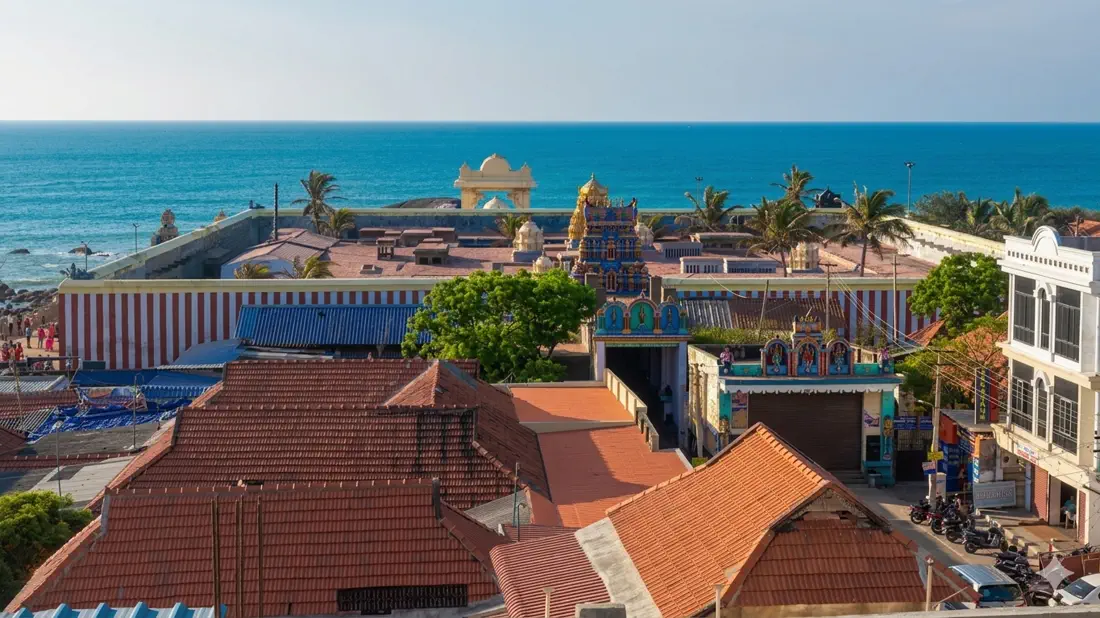
Look at the relationship between the enclosure, entrances and the coastal setting. Where access is permitted, observe how worship and circulation organise the building. Follow the people responsible for the shrine on entry, dress, footwear and photography.
Avoid attaching one age to every wall and hall. A sacred site may preserve a long tradition of worship while its visible buildings have changed through successive periods.
Legends and local traditions
Religious and local accounts in this section are traditions, distinct from dated historical records.
The interrupted wedding and the defeat of Banasura
In the religious account recorded by the district administration, the goddess takes the form of a maiden to defeat Banasura, who can be overcome only by a virgin. Her marriage to Shiva is arranged, but Narada understands that the wedding would prevent the promised defeat of the demon. Disguised as a rooster, he calls before dawn. Shiva, travelling from Suchindram, believes the auspicious time has passed and turns back.
The goddess remains unmarried and later destroys Banasura. Local versions add the abandoned wedding provisions and the coloured sands of the shore, linking ordinary materials with divine emotion. These are beliefs and storytelling traditions rather than explanations of sediment geology. Read in that way, the narrative connects the temple to Suchindram, to the route between the towns and to the shore itself. It explains why a pilgrimage can follow relationships between places, rather than simply moving between large buildings.
The nose ring and the sea-facing door
Another well-known temple story concerns the goddess's diamond nose ring. The Ministry of Tourism recounts the belief that its brilliance was mistaken for a guiding light by a sailor, bringing a vessel towards the dangerous shore. In that story, the sea-facing eastern door is closed to prevent a recurrence and opened on particular sacred occasions. The nose ring therefore becomes a link between the deity's adornment and the maritime setting outside the temple.
The legend imagines the goddess's radiance reaching from an enclosed sanctuary into a world of ships and sea journeys. That is a distinctive coastal setting for a temple story. The north-side approach used by visitors and the sea-facing eastern side place the shrine between two different worlds: the streets of a pilgrimage town and the open maritime horizon. Looking at those relationships gives the story a spatial setting even before entering the complex.
What makes this place unique?
The shrine explains the cape through a continuing goddess tradition, linking worship with the nearby sacred shore.
Combine this with nearby places
Combine the temple with Triveni Sangamam and the mainland Gandhi Memorial. These form a compact cape visit; the offshore monuments need separate ferry time.
Responsible visiting
The nose-ring, wedding and Banusura accounts belong to religious tradition. Ask before photographing people or rituals.
Quick summary
Kumari Amman Temple suits a worship-led visit to the cape. Allow 45–60 minutes as an editorial suggestion, with extra time for festivals and queues.
Sources for visitor information and transport
- Kanniyakumari District: temples and living traditions — Named shrines and devotional traditions; legends are tradition, not independently established history.
- District administration: Kumari Amman Temple — Numbered approach listings and Nagercoil–Suchindram–Kottaram corridor; destination in Kanniyakumari.
- District administration: How to Reach — Nagercoil has Vadasery for mofussil routes and Anna Bus Stand for local routes; Nagercoil and Kanniyakumari are rail arrival hubs. No individual numbered bus service verified by this general page.
- Southern Railway: Trivandrum Division station list (1 April 2022) — Station identities and codes only: Nagercoil Junction (NCJ), Nagercoil Town (NJT), Kanniyakumari (CAPE); not a current timetable or proof of the nearest station to each attraction.
Verification note
Editorial review: . Transport guidance follows the dated source record above; this is not a live timetable confirmation. Last verified for the explicitly sourced visitor details: 31 October 2026.
Historical references support the research passages they accompany. Editorial visit durations and recommendations are suggestions, not official operating information.