
At a glance
- Location
- Mandaikadu, coastal region near Colachel
- Recommended time
- 45–90 minutes; substantially longer during the festival
- Best for
- Pilgrims and visitors interested in living coastal religious traditions.
- Best time
- Choose an ordinary confirmed session for a quieter visit. For Masi Kodai, use the announced annual programme and allow substantial travel and queue time.
- Entry
- Confirm the day's worship session, admission and offering arrangements with the temple. Visitor information should be confirmed before travelling.
- Walking
- Allow for footwear-free walking and queues; festival routes can require a longer walk from the vehicle drop-off.
Before you go: Follow dress, footwear and photography rules.
Visit durations are editorial planning suggestions. Allow extra time for travel, queues and your group’s pace.
Why visit Mandaikadu Bhagavathi Amman Temple?
- Bhagavathi worship and the anthill-shrine tradition
- Women’s pilgrimage and the irumudi practice
- The Masi Kodai festival and surrounding community life
How to reach
By bus
The official Padmanabhapuram municipal route list identifies 45 and 47B between Thuckalay and Mandaikad. Its revision date is not given, so confirm the current number, temple stop and return service. Festival diversions and boarding arrangements require separate confirmation.
By train
Nagercoil Junction (NCJ) is a regional railway gateway; arrange a separate road transfer. Check your train's stopping station and travel-date timetable.
By road
Use Mandaikadu Bhagavathi Amman Temple as the full destination. Thuckalay is an officially listed approach town; confirm the final temple approach and any festival traffic controls.
Official route listings checked: . Padmanabhapuram Municipality: Train Schedule and Buses; Kanniyakumari District Administration: Heritage and Culture.
Municipal route listing is undated and does not prove present operation, temple-gate stops, frequencies or fares. Festival special services are not a year-round timetable.
Visitor information
- Temple hours and entry
- Visitor information should be confirmed before travelling.
- Festival
- The town panchayat records a ten-day Masi Kodai tradition in March. This is recurring context, not a confirmed date for a particular year; use the temple's current notice.
Best time to visit
Choose an ordinary confirmed session for a quieter visit. For Masi Kodai, use the announced annual programme and allow substantial travel and queue time.
Masi Kodai customarily falls in February–March; confirm the announced programme before choosing dates. Allow extra time for crowds and worship. “Women’s Sabarimala” is a devotional comparison, not a requirement that every visitor follows identical vows.
Visitor information should be confirmed before travelling. Fees, permissions, facilities and last entry are not established unless explicitly sourced below.
Facilities, parking and accessibility
Confirm toilets, drinking water, parking, step-free access and assistance with the destination. A railway or bus arrival does not establish access to the entrance; plan any final walk or transfer for your group.
What to see and do
- Arrive during a confirmed temple session
- Follow the admitted worship route
- Allow space and extra travel time if a festival is taking place
Important things to know before visiting
Follow dress, footwear and photography rules. During festivals, establish the meeting point, return transport and approved crowd route before entering.
Best way to experience this place
For pilgrims, ask temple staff about the correct offering practice. Visitors should not assume that every worshipper follows identical vows.
History and story behind the place
A temple and its setting
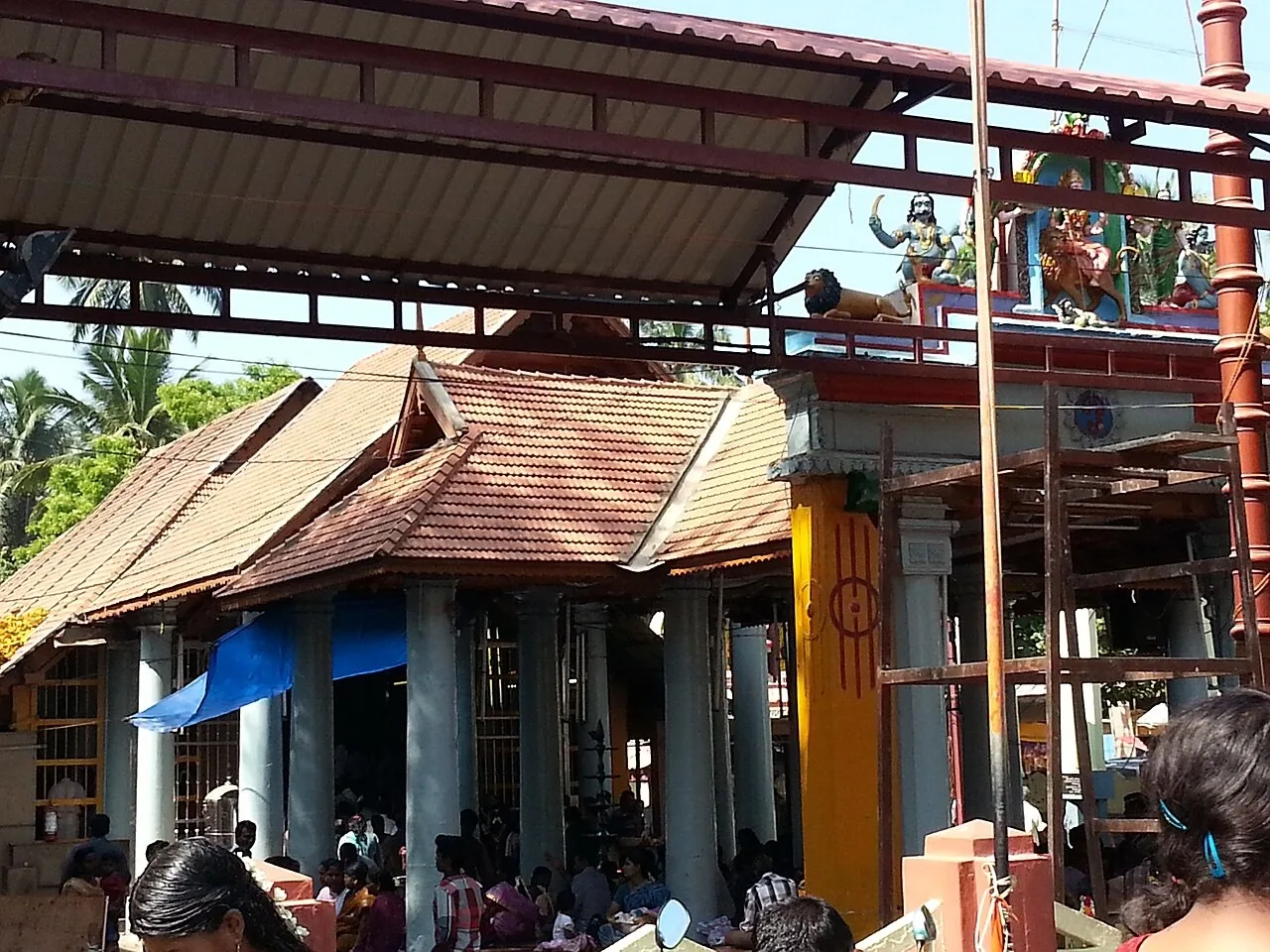
The district’s temple account describes Mandaikadu as a Kerala-style shrine and records the importance of women’s pilgrimage practice. The popular comparison with Sabarimala is a devotional description, not a substitute for the temple’s own identity.
Notice the building and its approaches alongside the surrounding settlement. The meaning of a place of worship comes from its present use as well as its architecture.
Bhagavathi and the anthill tradition
Mandaikadu's devotional identity centres on Bhagavathi Amman. The district's account describes the deity in association with an anthill, giving the shrine a different visual and religious focus from temples whose central image is a conventionally carved stone figure. The form matters because devotees encounter the goddess through a particular local sacred presence. It should be explained as a worship tradition rather than reduced to an unusual object on a sightseeing list.
Local tradition tells of Srichakra worship at a sacred spot where the anthill comes to embody the goddess. The story makes the place itself central to the shrine's origin: devotion is attached to a presence recognised in the ground, rather than only to an image brought from elsewhere. That gives the anthill its religious meaning. For a visitor, understanding the form of worship is more revealing than treating the shrine as an architectural curiosity.
What 'Sabarimala for women' is intended to convey
The district uses the familiar description 'Sabarimala for Women' and explains it through women arriving with irumudi, bundles containing offerings for the goddess. The comparison points towards a recognisable form of pilgrimage preparation and carrying offerings. It is most useful as an explanation of why Mandaikadu is widely associated with women's devotion, rather than as a claim that its deity, rites or access arrangements duplicate another temple.
Pilgrimage preparation extends worship beyond the temple. Vows, offerings and collective travel begin at home and continue on the journey, bringing family and group life into the sacred visit. At Mandaikadu, the prominence of women carrying irumudi gives that relationship a visible form. The bundle is part of the devotee's participation, carrying the materials and intention of worship into the temple rather than serving simply as a festival costume or souvenir.
Masi Kodai and the annual gathering
Mandaikadu Town Panchayat lists Masi Kodai as a ten-day festival, conventionally described in its profile under March. The Tamil month of Masi overlaps February and March, and the precise programme changes by year. This combination of a recurring season and an announced annual sequence is the right way to understand the event. A date copied from an earlier celebration cannot establish the next festival's timing.
During the gathering, the area around the shrine becomes part of the pilgrimage experience. Approaches, shops and shared movement support the religious programme. The ten-day festival brings the town into a different rhythm from an ordinary visit, with worship and the practical work of receiving pilgrims unfolding together. Watch how people arrive and prepare, as well as what takes place at the shrine: the celebration is sustained by many small acts of participation.
A western coastal shrine with its own architectural scale
The district describes the temple as built in the Kerala tradition and in a simple style. That is a useful invitation to look beyond expectations of a towering entrance gopuram. Roof forms, the relationship between enclosure and approach, materials and the scale of the worship space can be more revealing. The shrine's significance is carried by its religious life and festival as well as its architectural appearance.
Its location also makes Mandaikadu an important part of a western-coast itinerary. Colachel introduces the historic port and battle memorial, while Muttom adds the rocky shore and lighthouse. These are complementary places rather than interchangeable coastal stops. A day that allows for the temple's worship schedule and time in a coastal town gives the western district a fuller identity than a route consisting only of inland heritage sites and reservoirs.
Traditions need their own context
The official district account refers to women carrying irumudi. Details of vows, preparations and observance should come from the temple and the community practising them.
Different devotees may describe their experience differently. Presenting one explanation as a rule for everyone can obscure the living variation within a tradition.
Festival season and annual dates
Mandaikadu’s Kodai is a recurring festival tradition. The season belongs in an enduring introduction, while dates, services, processions and traffic arrangements need the organiser’s current notice.
The festival story connects Mandaikadu with other celebrations across the district. The calendar keeps dated programmes distinct from customary periods.
Irumudi explains a pilgrimage practice, not an identical temple system
The district account’s comparison with Sabarimala is connected with women carrying irumudi, a bundle of offerings. It is useful for understanding the pilgrimage emphasis, but Mandaikadu’s deity, anthill tradition and local observances retain their own identities. The comparison should not be used to import another shrine’s rules or vow sequence.
The temple’s simple Kerala-style form and its western coastal setting also give it a different visual character from Suchindram’s monumental stone complex. During Masi Kodai, the gathering extends the shrine’s life into a larger public occasion. On an ordinary day, the relationship between the shrine, its trees and its surrounding settlement offers another way to understand the place. The current programme determines the annual festival’s practical arrangements.
Visit as a guest
Follow the temple’s present dress, entry and photography arrangements. During a festival, leave space for worship and for volunteers managing movement.
A temple stop can be part of a coastal journey, but the time needed during an observance may differ from an ordinary day. Check the return connection rather than assuming an everyday transport pattern.
What makes this place unique?
The shrine's anthill tradition and women's irumudi pilgrimage connect local goddess worship with a wider devotional journey.
Combine this with nearby places
Pair Mandaikadu with Colachel on a coastal road outing outside crowded festival periods. Muttom is a separate coastal leg if time permits.
Responsible visiting
Ask before photographing devotees or offerings. Keep ritual explanations attributed to temple tradition.
Quick summary
Mandaikadu is best planned around worship or the announced festival. Allow 45–90 minutes as an editorial suggestion on an ordinary day and much longer during Masi Kodai.
Sources for visitor information and transport
- Mandaikadu Town Panchayat: town profile — Bhagavathi temple identity, Masi Kodai tradition and Eraniel rail approach; not the current annual festival date.
- Kanniyakumari District: temples and living traditions — Named shrines and devotional traditions; legends are tradition, not independently established history.
- Padmanabhapuram Municipality: Train Schedule and Buses — Official published route endpoints through Thuckalay; no route-table revision date or live service confirmation. Full page retrieved by HTTP on 2026-10-31.
- Kanniyakumari District Administration: Heritage and Culture — Records special services for the Mandaikadu festival; does not establish current festival-specific departures or route numbers.
- Southern Railway: Thiruvananthapuram division station list — Station identities/codes NCJ, ERL and KZT only; not a current train timetable, last-mile distance survey or proof of nearest station.
Verification note
Editorial review: . Transport guidance follows the dated source record above; this is not a live timetable confirmation. Current opening hours, fees and permissions have not been independently verified.
Historical references support the research passages they accompany. Editorial visit durations and recommendations are suggestions, not official operating information.